
CEO Pulse Podcast | Interview
TL;DR
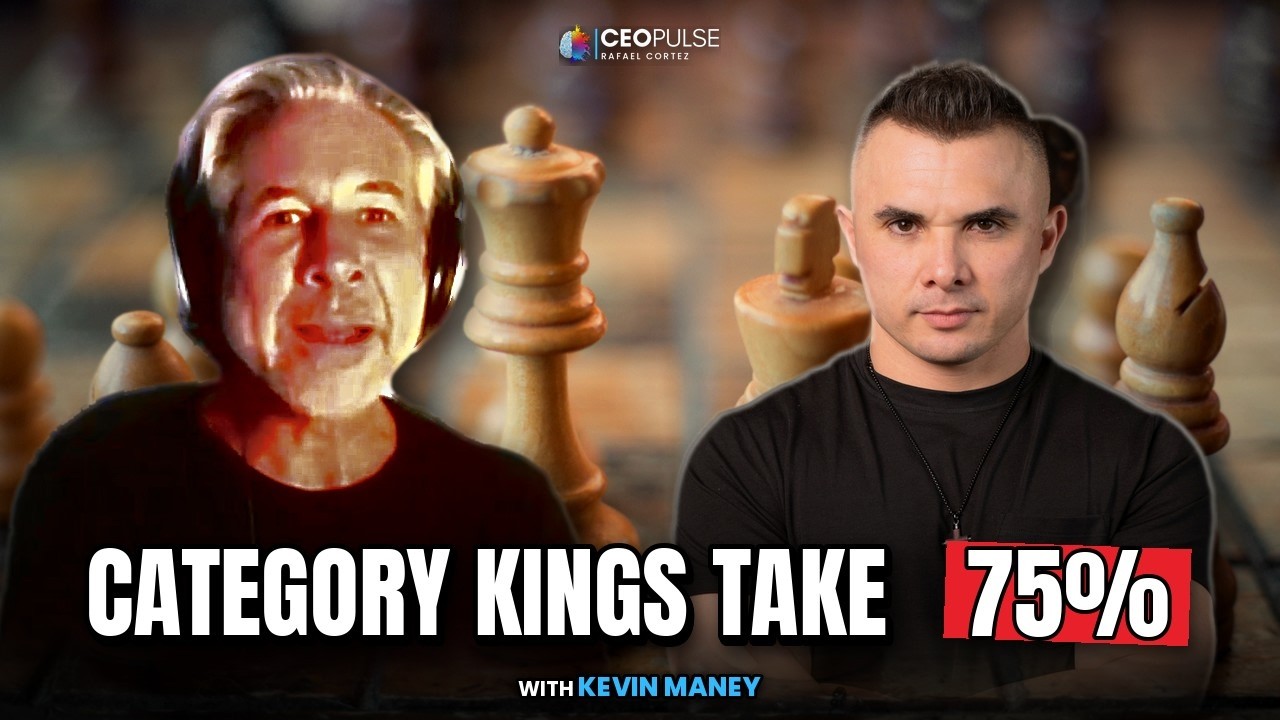
In this CEO Pulse Podcast interview, Rafael Cortez talks with Kevin Maney, a journalist who has covered tech and society for 30 years and coauthor of Play Bigger. He explains category design, why great companies start with the problem they solve, how category kings win and how a superhero style narrative aligns a team.
What you will learn in this episode
- How a 2006 meeting with Jeff Bezos about cloud computing shaped Kevin Maney's work
- What category design is and why category leaders take most of a market
- Why the first question is what problem you really solve
- Lessons from the iPad, Google search and the Chrysler minivan
- How the superhero narrative structure builds a company point of view
- Why you should talk about different, not better
How do companies create and own a new category?
Who is Kevin Maney?
Rafael Cortez, host of the CEO Pulse Podcast and an Organizational Psychologist, welcomes Kevin Maney, an author and columnist who has covered technology and society for about 30 years. He is coauthor of Play Bigger: How Pirates, Dreamers, and Innovators Create and Dominate Markets, and runs a practice called Category Design Advisors.
Kevin Maney was a longtime technology columnist for USA Today, where his job was to explain complex technology simply. He interviewed Jeff Bezos several times in Amazon's early days. In 2006, at a conference in San Francisco, Bezos's team called him up to a suite, where Bezos spent about 20 minutes explaining something called the Elastic Compute Cloud, long before cloud computing was a household idea. Kevin Maney asked how he would ever explain this to the world. Bezos said that was why Kevin was there. That product became AWS, a multibillion dollar business that spawned an industry.
After many books, Kevin Maney worked with three Silicon Valley startup advisors on Play Bigger, published in 2016. CEOs and venture investors began asking the authors to help their companies do what the book described, and clear articulation turned into his main work.
Why is simplifying the story so hard for founders?
Rafael Cortez says ideas arrive as a cloud, not in a straight line, and making them linear and understandable is a special talent. Kevin Maney adds that founders and teams who have spent two years heads down building rarely have time to look up and see the broader context. Their job is to build; telling the story is a different job. A few leaders, like Steve Jobs, do it intuitively, but most benefit from an outside person. Rafael Cortez notes that without clear messaging, people do not know what they are buying into, no matter how good the product is.
What is category design?
Kevin Maney explains that in almost any digital market, one company dominates and takes about 75% of the revenue, perhaps with a number two, as with Uber and Lyft, and everyone else trails. If the way to build a great company is to create, define and own a category, why enter someone else's space and argue you are better? That is just grasping for share. Instead, shift slightly to the side so you offer something that feels new.
Aligning the leadership team
The process matters inside the company too. Kevin Maney gathers six to 10 leaders around a whiteboard, and when a company is three or four years old, eight people in the room usually hold eight different ideas of what the company does and where it is going. Getting alignment is part of the work. Rafael Cortez has seen the same in his own consulting, where some leaders welcome new strategies and others ask why change what works.
What problem do you really solve?
The first question Kevin Maney asks is surprisingly hard: what problem do you really solve? Most companies describe what their product does and leave the customer to figure out why it matters. He sometimes spends a six hour day just on the problem, who has it, how they feel it and what they want. A great category solves a problem people know they have but cannot solve, or solve badly, or better yet, one they do not know they have until you explain it. Rafael Cortez admits he has always started from problems people already feel, never from problems they do not yet know about.
Which companies show category creation in action?
When Steve Jobs introduced the iPad, he first described a new world of digital media, then showed that a phone screen was too small and a laptop too bulky for the couch. Only then did he present the iPad as a new category of computing. Tablets had existed for a decade, and Microsoft marketed one heavily, but it was a laptop with a screen you could write on and never framed a new problem. Kevin Maney says a product that does something interesting is not a market; seeing the space first is what builds great companies.
Our brains think in categories. A grocery store is arranged by category, not alphabetically, and in business to business sales a category is a budget line item. Become the first name people think of for that line item and you are hard to dislodge. Microsoft spent heavily, roughly 10 billion dollars by Kevin Maney's estimate, to promote Bing, but people still say Google it because the category king was already set.
The Chrysler minivan
In the 1980s, Chrysler was struggling and could not credibly claim it built better cars than Japanese automakers. Instead, it saw baby boomers moving to the suburbs and having more kids, stuck between station wagons and tall vans that drove like trucks. Chrysler created the minivan and marketed the category itself. Decades later, Kevin Maney says, the company still holds about 50% of the global minivan market. Rafael Cortez compares it to a horror movie: you were not worried about break ins until the movie planted the idea, and then you check every door.
How does a superhero narrative help a business?
Humans are wired for narratives, not lists of facts. Kevin Maney structures every company story like a superhero movie; Rafael Cortez picks Iron Man. A villain arrives and the world falls into chaos while nothing can stop it. That villain is the problem. Then the hero, the new category, appears, you learn what its tools are and watch it solve the problem, and finally you see the better world. Only at the end does the company say it is the one doing this. Rafael Cortez sums it up: close the story with I am Iron Man.
Kevin Maney writes this point of view, or POV, with the leadership team so everyone owns it, usually 800 to 1,000 words. It rolls out first to employees, suppliers, contractors and partners, then informs the website, videos, commercials, investor decks and sales decks. Product and engineering teams use it to build with focus instead of bolting on random features. Rafael Cortez says new hires on his teams once saw only tasks without purpose, and a clear narrative creates real buy in. He contrasts spec heavy computer ads with Apple's simple message.
Different, not better
For a business that feels stuck, Kevin Maney says stop pushing out what you do and start explaining why people need it. If you hear yourself saying faster or more features, you are scraping market share from someone else. Talk about different, not better. Asked what he would tell his 17 year old self, Kevin Maney says do not quit music. He stopped playing as a teenager and did not return until his 40s, and playing in a band in New York is now one of the joys of his life. Rafael Cortez, who also plays guitar, relates to that joy.
Key takeaways
- Own a category. Kevin Maney says category leaders typically take most of a market's revenue.
- Start with the problem. Define what problem you really solve before describing your product.
- Find unseen problems. The strongest categories solve problems people did not know they had.
- Tell a hero story. Villain, hero, solution and a better world make a narrative a team can rally around.
- Different beats better. Arguing you are faster or better only scrapes market share.
Quotes from the conversation
“Just having a product that does something interesting is not a market.”
Kevin Maney, 19:38
“Our brains think in terms of categories, especially when there's a lot of choice out there.”
Kevin Maney, 21:44
“You want to be talking about different not better”
Kevin Maney, 41:42
Episode chapters
| 0:00 | Welcome Kevin Maney |
| 1:36 | Explaining the cloud for Jeff Bezos |
| 3:54 | Play Bigger and category design |
| 8:41 | Why category leaders win |
| 11:07 | Aligning the leadership team |
| 12:38 | What problem do you really solve? |
| 15:47 | Steve Jobs and the iPad |
| 23:52 | The Chrysler minivan |
| 27:47 | The superhero narrative |
| 40:35 | Different, not better |
Who is on this episode?
Kevin Maney
Kevin Maney is a journalist who has covered technology and society for about 30 years, including as a longtime technology columnist for USA Today. He is coauthor of Play Bigger and runs Category Design Advisors, helping companies define and own new market categories.
About the host: Rafael Cortez
Rafael Cortez is the host of the CEO Pulse Podcast, an Organizational Psychologist and a real estate broker and investor based in Phoenix, Arizona. Raised in Yuma, Arizona, he became one of the youngest firefighters in Yuma County at 19 and launched his first business at 21. He has been involved in more than 1,300 real estate deals since 2009 and mentors entrepreneurs through the L.E.S.S. Business philosophy: Lean, Effective, Strategic, Simple. Rafael is the founder of CEO Pulse, Pulse Realty and Pulse Capital and the creator of REI Pulse CRM, and he mentors wholesalers in group and 1 on 1 settings. Read Rafael Cortez’s full bio.
Questions and answers
Who is Kevin Maney?
Kevin Maney is a journalist who has covered technology for about 30 years and coauthor of Play Bigger. He tells Rafael Cortez he now helps companies with category design through Category Design Advisors.
What is category design?
Category design means finding a new market space, defining it and owning it instead of competing for share in someone else's market. Kevin Maney says category leaders usually take most of the revenue in their space.
Why should a company start with the problem it solves?
Most companies describe what their product does and leave customers to work out why it matters. Kevin Maney says defining the real problem, who has it and how they feel it unlocks the category and the narrative.
How did Chrysler create the minivan category?
Chrysler saw families moving to the suburbs with no good vehicle for growing kids and created the minivan as a new category. Kevin Maney says it still holds about half of the global minivan market decades later.
What narrative structure does Kevin Maney use?
Kevin Maney uses the plot of a superhero movie: a villain creates chaos, a hero arrives with new tools, solves the problem and leaves a better world. Only at the end does the company say it is the hero, which Rafael Cortez compares to Iron Man.
What does different, not better mean?
Kevin Maney says if you describe your product as faster or with more features, you are fighting for someone else's market share. Talking about how you are different opens a new space you can own.
Related episodes
Build your business on systems
Rafael Cortez built REI Pulse CRM from the systems he runs his own deals on. See how it works for wholesalers and investors.
Explore REI PulseBrowse every CEO Pulse Podcast episode · About Rafael Cortez · YouTube · Apple Podcasts · Spotify
