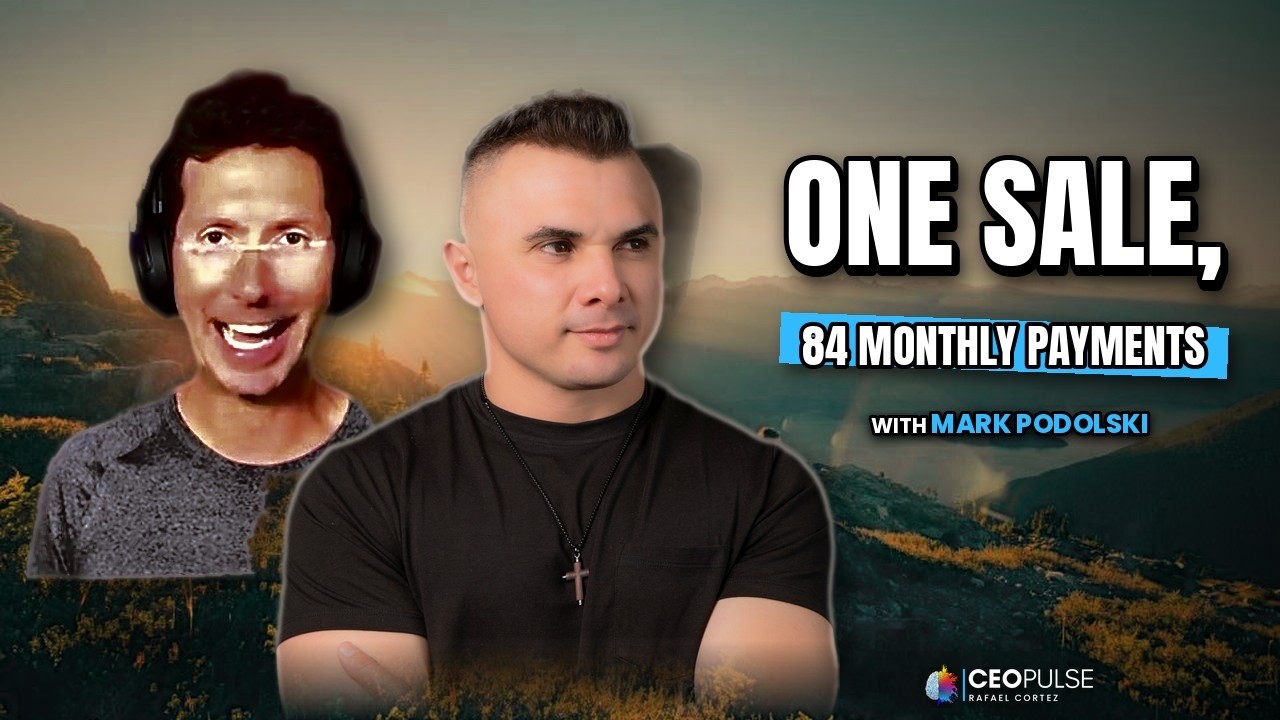

CEO Pulse Podcast | Interview
TL;DR
In this CEO Pulse Podcast interview, Rafael Cortez talks with Mark Podolski, The Land Geek, who has bought and sold raw land since 2001 with over 6,000 transactions. He explains how he left investment banking, how his offer and owner financing model works, and why entrepreneurs need belief, skills and traits.
What you will learn in this episode
- How Mark Podolski turned 3,000 dollars of savings into a full time land business
- Why a mentor told him he had built a better job, not a business
- The three things every entrepreneur needs: belief, skills and traits
- How his raw land offer formula and due diligence checklist work
- How selling land with owner financing creates monthly passive income
- Why he would tell his 17 year old self to meditate
How does a former investment banker build a raw land business?
Who is Mark Podolski, The Land Geek?
Rafael Cortez, host of the CEO Pulse Podcast and an Organizational Psychologist, admits he is a little starstruck. When he came across a land deal around 2014 and had no idea how to value it, Mark Podolski's content was one of the first places Rafael turned. Mark Podolski, known as The Land Geek, has been in the land business since 2001, has done over 6,000 unique transactions and has helped hundreds of students learn the model.
In 2000, Mark Podolski was an overstressed, micromanaged investment banker specializing in mergers and acquisitions with private equity groups, with a 45 minute commute each way. It got so bad he had the Friday blues, dreading how fast the weekend would go. Then his firm hired a man who bought raw land for pennies on the dollar as a side hustle and flipped it online for a 300% return. Mark Podolski, used to seeing great companies run on 10 to 15% margins, did not believe him.
The first 10 parcels
With about 3,000 dollars he had saved for car repairs, Mark Podolski went to New Mexico and did exactly what he was told. He bought 10 half acre parcels at an average of 300 dollars each and sold them online for an average of 1,200 dollars each, all in less than 30 days. He rolled the money into another auction in Arizona, where almost no one was in the room, sold that land over about six months and made over 90,000 dollars cash. His pregnant wife said absolutely not to quitting, so he waited until his land income exceeded his banking income, which took about 18 months.
Why did his mentor say he only had a better job?
Leaving was hard. Mark Podolski says he felt sick about quitting because he could only see what he would lose: benefits, salary, prestige and the identity of being an investment banker. He did not see what he would gain, which was 100% of his time, attention and talent going into his own work. Today, when people whose passive income exceeds their fixed expenses ask whether to quit their job, he says yes.
Over coffee, Mark Podolski bragged to his mentor, Ori, who had sold his company to Experian for 360 million dollars, that he was a pretty good entrepreneur. Ori stopped him. If Mark died tomorrow, what would happen to his company, Frontier Properties? He had built himself a better job. That is when Mark Podolski put systems, processes and software in place and took the business to the next level. Rafael Cortez calls mentorship the number one way to cut the learning curve, with working for someone already doing it a close second, and says it is not an expense but an investment.
Mark Podolski calls himself ambitiously lazy: if someone has already done what he wants to do, he will learn from them or hire them. His philosophy is simple: he can always make more money, but he cannot get more time.
How did The Land Geek brand start?
While Mark Podolski was on vacation, a man who found his Frontier Properties website asked to learn his model and offered to pay. His wife worried he was creating his own competition, so he put on his investment banker hat and sized the market: billions of acres for sale and no private equity groups or hedge funds, just a cottage industry. A million people could be in the niche and all run out of money before they ran out of deal flow. He recorded himself showing that first student the business and turned it into a course with help from a consultant. While listening to a marketing audiobook on a walk, he decided people would not remember his name, but he was pretty geeky, so he became The Land Geek in 2013.
Mark Podolski believes we should reevaluate every 10 years. Anyone who wants to retire and play golf will be bored in about a week. After a decade of comfort in land he wanted a new challenge, which became mentoring students, and now he is writing his second book and looking for the next struggle.
What three things does every entrepreneur need?
Mark Podolski says entrepreneurs need belief, skills and traits, and the business will expose whichever one is missing. Belief means believing you can launch, believing in your market and believing you provide value. Skills are selling, marketing, attracting talent and managing money. Traits are where people sabotage themselves by lying, cheating or being difficult to work with, so self improvement is required to lead others toward your vision.
Rafael Cortez adds that leaders must evolve with their businesses; the way you started will not carry you to a multimillion dollar company. Mark Podolski compares a business to a new baby: it exposes every crack in a relationship, and a business exposes every crack in your traits until you see that you are the constraint. He recommends Ryan Holiday's Ego Is the Enemy.
Facing the fear of risk
One of Mark Podolski's hardest moments was borrowing a million dollars for a deal. He understood interest rates and spreadsheets, but his father had been a debt free small business owner, and emotionally he was not ready. He went to someone comfortable borrowing at that level, who pushed him to do it, and he ended up making 5 million dollars on the deal. He calls himself risk averse and right between introvert and extrovert. Yet he argues that when you truly understand a business and have belief, skills and traits, there is little real risk, because you can pivot. He points to Grant Cardone and Gary Vee as people who could lose everything and rebuild.
How does Mark Podolski's raw land model work?
Most real estate investors are landlords, wholesalers and flippers, which is why land is a less competitive niche. Mark Podolski walks Rafael Cortez through an example. Suppose Rafael lives in Phoenix and owns 10 acres in Texas with 200 dollars in back taxes. That signals no emotional attachment and some financial distress. Mark Podolski takes the lowest comparable sale from the last 12 to 18 months and divides by four, what Warren Buffett would call a margin of safety, and mails an offer, perhaps 2,500 dollars. About 3 to 5% of owners accept.
Then comes due diligence: confirming the back taxes, a clean chain of title, no liens, road access, zoning restrictions, neighbors and distance to services. He pays someone about 50 dollars to visit and report on the property, and an outsourced team pulls plat, aerial and satellite maps. On properties worth 5,000 dollars or more, he closes through a title company.
Selling with owner financing
His first buyers are the neighbors, who get letters about protecting their privacy and views. Next comes his buyers list, then Craigslist, Facebook Marketplace and land listing platforms. He makes the offer irresistible, like a car payment: 2,500 dollars down to control the parcel, then monthly payments at 9% interest for 84 months. The down payment returns his purchase price, so the note is pure cash flow with no renters, rehabs or rodents. The goal is enough land notes that passive income exceeds fixed expenses. His one regret is not starting owner financing until 2007. He took a big hit around 2010, when land fell as housing recovered, and rebalanced his portfolio by about 2012.
Why meditation is his advice to his younger self
Asked what he would tell his 17 year old self, Mark Podolski instantly says learn to meditate. The quality of our lives reflects the quality of our minds and how we interpret events. Awareness lets you notice a thought, like disappointment at a cloudy day in Phoenix, without attaching to it. Entrepreneurship is a struggle and will not make you happy on its own; too many founders reach the top of the mountain and feel empty. Meditation, awareness and gratitude are a separate skill set for happiness, and he believes his 20s and 30s would have been much happier with them.
Rafael Cortez shares his own morning practice of meditation and gratitude journaling, which keeps him present instead of thinking about a deal while on a beach with loved ones. His advice to his own 17 year old self: think big, believe in yourself and meditate.
Key takeaways
- Mentorship is an investment. Mark Podolski and Rafael Cortez agree that learning from someone who has done it cuts the learning curve.
- Build a business, not a better job. Systems, processes and software let a company run without you.
- Belief, skills and traits. Your business will expose whichever one you are missing.
- Buy with a margin of safety. Mark Podolski offers a fraction of the lowest comparable sale and does careful due diligence.
- Mind your mind. Meditation and gratitude are a separate skill set for happiness as an entrepreneur.
Quotes from the conversation
“I can always make more money. I can't get more time.”
Mark Podolski, 9:40
“We need belief, we need skills and we need traits.”
Mark Podolski, 15:40
“The quality of our lives are sort of equated by the quality of our minds.”
Mark Podolski, 35:58
Episode chapters
| 0:00 | Welcome Mark Podolski, The Land Geek |
| 1:43 | From investment banker to land investor |
| 6:32 | A mentor's wake up call |
| 9:40 | Starting The Land Geek |
| 15:14 | Belief, skills and traits |
| 19:58 | Borrowing a million dollars |
| 25:23 | How the raw land model works |
| 28:38 | Selling land with owner financing |
| 35:38 | Advice to his 17 year old self: meditate |
Who is on this episode?
Mark Podolski
Mark Podolski, known as The Land Geek, is a former investment banker who has bought and sold raw, undeveloped land since 2001 and has completed over 6,000 transactions. He launched The Land Geek brand in 2013 and helps students across the country learn his land investing model.
About the host: Rafael Cortez
Rafael Cortez is the host of the CEO Pulse Podcast, an Organizational Psychologist and a real estate broker and investor based in Phoenix, Arizona. Raised in Yuma, Arizona, he became one of the youngest firefighters in Yuma County at 19 and launched his first business at 21. He has been involved in more than 1,300 real estate deals since 2009 and mentors entrepreneurs through the L.E.S.S. Business philosophy: Lean, Effective, Strategic, Simple. Rafael is the founder of CEO Pulse, Pulse Realty and Pulse Capital and the creator of REI Pulse CRM, and he mentors wholesalers in group and 1 on 1 settings. Read Rafael Cortez’s full bio.
Questions and answers
Who is Mark Podolski?
Mark Podolski, The Land Geek, is a former investment banker who has invested in raw land since 2001 with over 6,000 transactions. He tells Rafael Cortez how a 3,000 dollar test in New Mexico became a full time business.
How does Mark Podolski price raw land offers?
Mark Podolski takes the lowest comparable sale from the last 12 to 18 months and divides by four, which gives him a large margin of safety. He says about 3 to 5% of owners accept his offers.
How does owner financing raw land create passive income?
Mark Podolski sells parcels with a down payment that covers his purchase price, then collects monthly payments with interest for several years. With no tenants or rehabs, the notes become passive income.
What three things does every entrepreneur need?
Mark Podolski says belief, skills and traits. If any one is missing, the business will expose it, so entrepreneurs must keep working on themselves.
Why is land investing less competitive?
Mark Podolski says most investors at a real estate meeting are landlords, wholesalers and flippers, and land has no private equity or hedge fund players. Rafael Cortez notes that land is simply less glamorous than other strategies.
What would Mark Podolski tell his 17 year old self?
Learn to meditate. Mark Podolski says the quality of your life reflects the quality of your mind, and awareness and gratitude would have made his 20s and 30s happier.
Related episodes
Build your business on systems
Rafael Cortez built REI Pulse CRM from the systems he runs his own deals on. See how it works for wholesalers and investors.
Explore REI PulseBrowse every CEO Pulse Podcast episode · About Rafael Cortez · YouTube · Apple Podcasts · Spotify
