
CEO Pulse Podcast | Interview
TL;DR
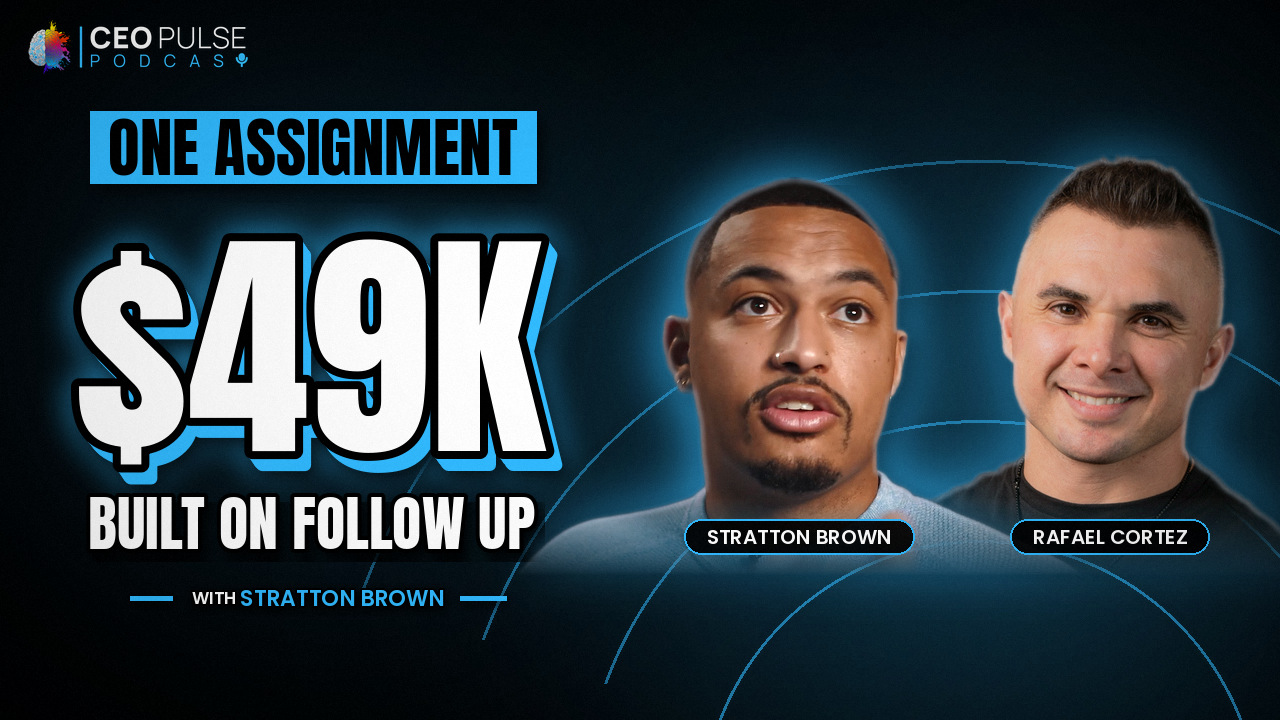
In EP 260 of the CEO Pulse Podcast, host Rafael Cortez talks with Stratton Brown, a real estate wholesaler and former college football player, about the wholesaling basics that make money: one consistent marketing channel, real conversations with sellers, screening for price, timeline, condition and motivation, and the follow up that turned a Hanford, California lead into a $49,000 assignment.
What you will learn in this episode
- How Stratton Brown went from an NFL tryout in Seattle to knocking on pre foreclosure doors
- Why working for an established wholesaler for about a year and a half felt like an MBA in real estate
- Why one backbone form of marketing, kept running through the holidays, beats jumping between channels
- How his team screens every lead for price, timeline, condition and motivation
- Why he looks at markets with more than 200,000 people and leans on high equity absentee owner lists
- How the Hanford deal worked: an ARV of about $270,000, a contract at $130,000 and a $49,000 assignment
- His top three tips for new wholesalers: talk to sellers, use a CRM and get a dialer
What do Rafael Cortez and Stratton Brown cover in this episode?
Who is Stratton Brown and how did he get into real estate?
Rafael Cortez opens EP 260 by telling listeners he has known Stratton Brown for a while, has talked through a ton of deals with him, and wants to dig into a big deal Stratton recently closed. Stratton starts with his background: he was a college football player, all conference his senior year and 17th in the country in tackles, and he expected to make a lot of money. Worried about ending up rich to broke, he filled his head with Wholesaling Inc, BiggerPockets, Dave Ramsey and Grant Cardone.
He got a tryout in Seattle, a cup of coffee as he puts it, and nothing happened. Back home he decided to start a career and launched a home inspection business, which he calls awful after crawling under a house with spiders in his face. At a meetup he met a man who had gone from driving a tractor for about $30,000 a year to making several six figures a month wholesaling, and who owned close to 100 rentals.
That investor told him to download PropertyRadar and knock on every pre foreclosure. Stratton knocked from dawn until the sun went down, day after day, until he finally got a deal. He then worked for that investor for about a year and a half before starting his own company at the beginning of 2018.
Why does Stratton Brown call working for another wholesaler an MBA in real estate?
Stratton Brown says he eventually ran a lot of the day to day for that investor. It felt like being a partner: putting together marketing campaigns, building an in house call center of about eight people, choosing the marketing, running the office, and managing another acquisitions agent and a transaction coordinator.
When it was time to part ways, he calls the move the best thing he has ever done. His message to anyone skeptical about paying for mentorship or working for someone for free is simple: do not be, because he got an MBA in real estate in about a year and a half. Rafael Cortez adds that the margins in wholesaling are big and the overhead is minimal compared with a brick and mortar business, and that the opportunity was still there even after the big change at the beginning of 2020.
What marketing does Stratton Brown rely on?
Today his team is lean. He is bringing on a new leads manager, and his call center handles the cold calls. He does some very targeted texting, nothing too heavy given the new opt out rules, plus PPC. Cold calling is without a doubt number one for him. PPC has a higher barrier to entry, but it is nicer because the sellers come to you. For someone just getting started, he says cold calling is hands down the way to go.
Rafael Cortez presses the point: you need one backbone form of marketing, a pillar you test, prove and never stop running. One mistake he sees is people dialing back their marketing going into the holidays. People still have problems that need solving, and if you slow down now, you will not see profits in January or February. Asked about his highest revenue generating activity, Stratton answers in three words: talking to sellers.
How does Stratton Brown screen sellers?
Rafael Cortez notes that it is never only about the money, and Stratton Brown says that if a seller is going to shop your offer, you are rarely going to win. Small margin deals often bring the biggest headaches. What wins is long follow up that builds rapport, until it is just you and the seller putting something together. Both agree you should never try to convince someone to sell: making people think they have a problem just to get a property is unethical and creates big problems during the transaction.
His team screens on price, timeline, property condition and motivation, and for Stratton motivation comes first. He wants something that can sell within 90 days. Leads outside that window are not dropped. They go into follow up month after month, and he is honest with sellers: if it does not sound like they are ready, he asks if he can give them a quick 30 second call in about 30 days. They nearly always say yes, and if they say 60 days, he still calls in 30.
He shares an example of solving the real problem. On an inherited house with a squatter in the middle of COVID, he offered to buy it with the squatter in place, handle cash for keys, close in two weeks, and give the family time to go through the house before closing. Solving the problems no one else thought about, he says, matters more than price. Both have seen sellers grab a bag and walk out, leaving the rest of the house behind.
How did a football player become a full time wholesaler?
Rafael Cortez asks how Stratton Brown got over the fear of going full time and trusting himself to run an operation. Stratton says he had no other life skills. He had spent 23 years developing himself as a football player, had a degree in communication and did not want a real job. With his back against the wall and dead broke, he had to make something happen, and even after working for the investor, doing his first deal on his own with his own money felt like starting over.
Rafael Cortez says he sees it time and time again: once you hit that first deal and get a settlement statement that says you closed, everything becomes real. Stratton calls it proof of concept. It is one thing to watch people talk about it on YouTube, he says, but to get the check in your hand and go cash it tells you that you really did this and can do it again.
How did the Hanford, California deal come together?
Stratton Brown calls it the most bizarre deal he has experienced. The owners were an older retired couple who lived on the coast. Their grandson, a police officer, lived in the house in Hanford, and they were tired of driving about two and a half hours to fix it up and check on it. It came in from texting a high equity absentee owner list, in an area about an hour from his main market. The wife answered the text, and Stratton followed up with her for three months before she put him on the phone with her husband.
Once they talked, the deal moved in a day. The husband said the house was in really bad shape, gave him a price and wanted to close in 60 days. Stratton stayed on the phone while the husband checked with his wife, sent the contract over virtually, and never saw the sellers or the house. The main concern was giving the grandson time to move, so they structured it as cash with a 60 day escrow, no inspections and no contingencies.
He did not close it himself. He assigned the contract through a California wholesaler meetup group with about 700 buyers and other members and got bites right away. The buyer showed proof of funds and put down earnest money, which Stratton says is usually $2,500 to $5,000 depending on the relationship.
What are the numbers on the $49,000 assignment?
Stratton Brown says the ARV was about $270,000 and the contract price was $130,000 on a house that did not need much work. He assigned it for $49,000. Rafael Cortez points out that from the first text to closing it was about a five month deal, three months of follow up plus the 60 day escrow, which works out to close to $9,000 a month for following up. Wholesaling can be in and out in two weeks in the perfect scenario, he says, but most of the time you have to do the follow up work because the seller is not ready yet.
On negotiation, Stratton says he could always have anchored lower. A low anchor feels rude, like the seller is going to laugh you off the phone, but it is a conversation piece and a starting point, not your final number. The more you dig into the conversation, they agree, the more you find that the real problem is not the price, and a low anchor has never killed one of his negotiations.
What are Stratton Brown's top three tips for new wholesalers?
First, talk to sellers. Your LLC, your website and your logo do not matter if no one knows you want to buy their house at a discount. Second, use a CRM. He suggests Podio, which offers a free real estate investor pack, and says his CRM saves his life because he is not super organized. Third, get a dialer and start cold calling.
For anyone who says they cannot afford it, Stratton shares that when he first started on his own he donated blood and sold everything he had to afford a dialer, and lived on bananas and rice to pay rent. Rafael Cortez calls it hardcore and says it gave him a newfound respect. Driving for dollars can be a great kickstart, Stratton adds, but do whatever you have to do to get rolling and focus on those three things.
Key takeaways
- Pick one backbone channel. For Stratton Brown it is cold calling. Test it, prove it and keep it running, including through the holidays.
- Screen on four things. Price, timeline, property condition and motivation, with motivation first and a 90 day selling window.
- Follow up is the deal. The Hanford lead took three months of follow up before a single phone call put it under contract.
- Solve the real problem. A 60 day escrow so the grandson could move mattered more to the seller than squeezing the price.
- Anchor low. A low first number is a starting point for the conversation, and it has never killed one of his negotiations.
- Start with the basics. Talk to sellers, use a CRM and get a dialer before worrying about a logo or a website.
Quotes from the conversation
“I had no other life skills. I spent 23 years of developing myself as a football player.”
Stratton Brown, 15:39
“The fact that you get a settlement statement that says that you closed the deal makes everything real.”
Rafael Cortez, 16:28
“I’d rather lose a deal because of too much follow up than because I didn’t follow up enough.”
Rafael Cortez, 23:29
“You can always price anchor lower, honestly.”
Stratton Brown, 26:13
“Your website doesn’t matter. Your logo doesn’t matter. If no one knows you want to buy their house at a discount, then you’re not doing anything right.”
Stratton Brown, 30:52
Episode chapters
| 0:00 | Intro |
| 1:24 | From an NFL tryout in Seattle to knocking doors |
| 2:54 | Working for a wholesaler, then going solo |
| 5:54 | Cold calling, PPC, and targeted texting |
| 7:24 | Why consistency matters more than quick results |
| 8:54 | Everything comes from follow up |
| 11:54 | Screening for price, timeline, condition, and motivation |
| 16:24 | What your first closed deal really means |
| 17:54 | The Hanford deal: how the seller came in |
| 20:54 | Picking markets with more than 200,000 people |
| 26:54 | Your offer is an anchor |
| 29:34 | The numbers: $270,000 ARV, $130,000 contract, $49,000 assignment |
| 30:34 | Top three tips for new wholesalers |
Who is on this episode?
Stratton Brown
Stratton Brown is a real estate wholesaler and a former college football player who was all conference his senior year and earned an NFL tryout in Seattle. He started by knocking on pre foreclosure doors, worked for an established wholesaler for about a year and a half, and started his own wholesaling company at the beginning of 2018. His business runs on cold calling, targeted texting and PPC.
About the host: Rafael Cortez
Rafael Cortez is the host of the CEO Pulse Podcast, an Organizational Psychologist and a real estate broker and investor based in Phoenix, Arizona. Raised in Yuma, Arizona, he became one of the youngest firefighters in Yuma County at 19 and launched his first business at 21. He has been involved in more than 1,300 real estate deals since 2009 and mentors entrepreneurs through the L.E.S.S. Business philosophy: Lean, Effective, Strategic, Simple. Rafael is the founder of CEO Pulse, Pulse Realty and Pulse Capital and the creator of REI Pulse CRM, and he mentors wholesalers in group and 1 on 1 settings. Read Rafael Cortez’s full bio.
Questions and answers
Who is Stratton Brown on the CEO Pulse Podcast?
Stratton Brown is the guest on EP 260 with host Rafael Cortez. He is a real estate wholesaler and former college football player who started his own wholesaling company at the beginning of 2018.
How did Stratton Brown get started in wholesaling?
After an NFL tryout in Seattle and a short run as a home inspector, he met a wholesaler at a meetup who told him to download PropertyRadar and knock on every pre foreclosure. He knocked doors until he got a deal, then worked for that investor for about a year and a half.
What marketing works best for Stratton Brown?
Cold calling is without a doubt number one for him, supported by targeted texting and PPC. He tells new wholesalers that cold calling is hands down the best way to get started.
How does Stratton Brown qualify a seller?
He screens for price, timeline, property condition and motivation, with motivation first. He wants a property that can sell within 90 days and keeps everyone else in monthly follow up.
How did the $49,000 assignment happen?
A high equity absentee owner text reached a retired couple who owned a house in Hanford, California. After three months of follow up, one call put it under contract at $130,000 with a 60 day cash escrow. He assigned the contract for $49,000 on a house with an ARV of about $270,000.
How long did the Hanford deal take?
About five months: three months of follow up before the first real conversation, then a 60 day escrow.
How does Stratton Brown sell his contracts?
He sends deals to a California wholesaler meetup group with about 700 buyers and other members, asks for proof of funds, and takes earnest money of $2,500 to $5,000 depending on the relationship.
What markets does Stratton Brown look for?
When he taps into a new market, the first thing he checks is whether it has more than 200,000 people, so he can run a healthy amount of campaigns on high equity absentee owner lists.
What are his top three tips for new wholesalers?
Talk to sellers, use a CRM such as Podio, and get a dialer and start cold calling. He says your LLC, website and logo do not matter if no one knows you want to buy their house.
What did Stratton Brown do to afford his first dialer?
He says he donated blood and sold everything he had to afford a dialer when he first started on his own.
Related episodes
Try REI Pulse free for 15 days
Rafael Cortez built REI Pulse from the systems he runs his own deals on. Start a 15 day free trial and see how it works for wholesalers and investors.
Start the 15 day free trialBrowse every CEO Pulse Podcast episode · About Rafael Cortez · YouTube · Apple Podcasts · Spotify
