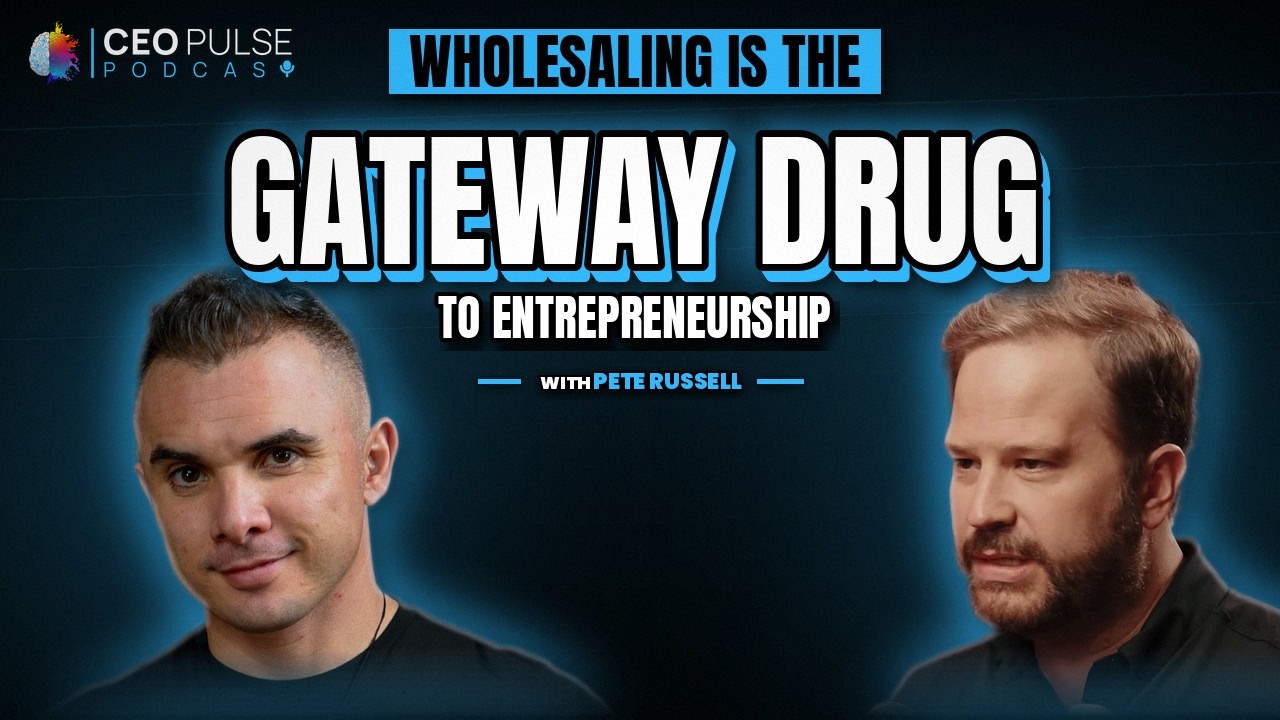

CEO Pulse Podcast | Interview
TL;DR
In EP 256 of the CEO Pulse Podcast, host Rafael Cortez talks with Pete Russell, a Charlotte, North Carolina wholesaler with over 500 wholesale deals since 2016 and the founder of Velocity Advantage Capital, about same day double closings, transactional funding, protecting your assignment fee, and the tenant who tried to wholesale the house he was being evicted from.
What you will learn in this episode
- How a friend's Facebook Live videos and a restaurant meetup got Pete Russell into wholesaling in 2016
- Why a $30,000 deal that fell apart almost made him quit, and what kept him going
- How his team grew to about 10 people doing deals in six or seven markets
- Why institutional buyers like Opendoor pushed him into same day double closings
- When a double close beats an assignment and how it can stop a buyer from retrading your fee
- How his funding works with no credit check and no underwriting, and why a proof of funds letter matters
- The tenant who tried to wholesale the house, and a fraudulent seller story from Rafael Cortez
What do Rafael Cortez and Pete Russell cover in this episode?
Who is Pete Russell and why is he on the CEO Pulse Podcast?
Rafael Cortez introduces Pete Russell as the founder of Velocity Advantage Capital and a very experienced wholesaler who has been doing it for close to a decade, with over 500 wholesale deals, who now funds transactional funding deals for other wholesalers. Rafael Cortez says what makes this conversation different is that most providers have not been through the trenches of wholesaling, and Pete Russell has.
How did a Facebook Live get Pete Russell into wholesaling?
Pete Russell tells Rafael Cortez he was always interested in real estate investing but thought you needed a rich uncle or a lot of capital. In 2016 a friend was posting Facebook Live videos walking through beat up properties he was putting under contract and planning to sell for 20 or 30 thousand dollars. Pete Russell called him, heard about it for an hour, and went to the friend's monthly meetup at the back of a restaurant, where 15 or 20 people sat around a long table talking about deals.
He stayed after to learn what an assignment was and how selling to a cash buyer worked. He and a business partner learned from Sean Terry's free YouTube videos and later paid for the Flip to Freedom course. Rafael Cortez shares that he worked acquisitions for Sean Terry for three years and first spoke at the Flip to Freedom event in 2015.
With 9 to 5 jobs, they put out bandit signs early in the morning, knocked on doors, left notes on abandoned properties and set up a Google Voice number. After about three or four months, they got their first deal, which Pete Russell recalls as about $25,000.
What was the $30,000 deal that almost made him quit?
Before that first check, Pete Russell says, one deal was lined up to make north of $30,000 with a buyer in place, and then the seller ghosted them. He calls that a line in the sand, the moment you have every excuse to quit. Rafael Cortez says there has to be a degree of blind faith and self belief to push through. Once the first deal finally paid, Pete Russell says, the question became how to make it happen more often.
How did Pete Russell scale to hundreds of deals?
Pete Russell says the team grew to as many as 10 people doing deals in different markets. He is based in Charlotte, North Carolina, and they closed deals in Dallas, Houston, Alabama and parts of Florida. Rafael Cortez notes that COVID pushed many investors to go virtual, and that once that genie was out of the bottle it was hard to put back.
When Rafael Cortez asks how they got past 500 deals at roughly 10 deals a month, Pete Russell says it was a bit of hustle and a bit of systems. They kept a minimal CRM and tracked cost per lead and cost per deal, had lead manager, acquisitions and dispo roles, and used a cold calling company, texting, mail, PPC and ringless voicemail across six or seven markets at a time.
Why did Opendoor push him into double closings?
Early in COVID, Pete Russell says, institutional buyers like Opendoor and Offerpad were paying strong prices for a vanilla box: three beds, two baths, 1,200 square feet or bigger, built after 1980. But they would not take assignments. You had to own the property, even for 10 minutes. His team had never double closed before, so they called around asking who would fund it.
Every lender was different. Some had to stand in line at the bank to send a wire, and many hard money lenders would not touch a double close. He says about 60 percent of his business at the time was going to institutional buyers, and the fees added up. Lenders charged him 3 or 4 percent, and on a $60,000 deal he did not mind, but at the end of a month or quarter with 10, 15 or 20 closings, the transactional funding fees were wild.
How did a janky process turn into Velocity Advantage Capital?
Pete Russell says the process was janky, so he asked what he would want as an investor: the same simple, predictable, streamlined process every time, without jumping through hoops, and lower fees. That led to Velocity Advantage Capital, a same day double closing business. He tested it on his own deals and with local wholesalers and investors in Charlotte before opening it up nationwide. Rafael Cortez points out that many entrepreneurs build a new business by fixing a problem for themselves first.
When does a double close beat an assignment?
Pete Russell says he is a wholesaler at heart. On a $5,000 or $10,000 deal, he tells people to assign it and keep their profit. The people who come to his company most are making a fee over about 20 or 25 thousand dollars, or they are in a market where assignments are restricted and some attorneys will not do them.
There is a third reason. On a 15 or 20 thousand dollar fee, some investors double close because they expect the end buyer to see the assignment fee and come back during due diligence with a crack in the foundation to retrade the price. A double close protects you from that, he says. Rafael Cortez adds that buyers can always look at public records later, but taking ownership puts you in a much safer spot. Pete Russell agrees that you control the asset, even if you only own it for 30 minutes, and on a $70,000 assignment fee you are not sitting at the closing table hoping it works out.
How much does a double close cost, and is there underwriting?
Pete Russell says that on about 90 percent of what they fund, they charge less than 1 percent, three quarters of a point plus a small admin fee per deal. On larger deals between $500,000 and a million, the fee goes up to a point. They have funded deals over a million, including an RV park in Arkansas that was being sold for $3 million.
He tells Rafael Cortez there is no credit check and no underwriting. They work with experienced investors and first timers alike. If you have a contract with the seller, a contract with the buyer and a closing date, you fill out a form and introduce them to whoever is handling the closing, whether that is an escrow officer or an attorney's paralegal. They fund on the day of closing once the end buyer is committed and their funds are in escrow, and the wholesaler does not have to bring a percentage to the table.
What does a proof of funds letter do?
Velocity Advantage Capital also provides proof of funds, Pete Russell says: a simple one pager with your LLC name, the subject property, the offer amount and his contact information so anyone can verify it. It makes offers that much stronger. Rafael Cortez notes that it matters when the company behind the letter can actually back the deal.
Right now the company only does double closings nationwide, wherever the closing company will do a same day double close. Pete Russell says they get a lot of requests for earnest money deposits and plan to look at that next, along with some private money lending in his own market.
The tenant who tried to wholesale his own eviction
Asked about his craziest deal, Pete Russell tells Rafael Cortez about a caller who said he was selling a property but was vague about the details and just told them to come see it. Pete Russell brought another team member because it felt off. The house was beat up, other investors were walking through it, and the man was dodgy with questions and left in a hurry when someone drove by.
A day or two later, the same address came in again, this time from the actual owner. When Pete Russell described the man who had shown them the house, the owner said that was his tenant, who he was in the process of evicting. The owner still wanted to sell and did not want a lot of back and forth, so they made a deal. Pete Russell says they made about $42,000 on it and sold it two or three weeks later. The tenant, he says, was trying to wholesale the property he was being evicted from, and part of him thought it was sleazy while part of him thought the man shot his shot.
The fraudulent seller who almost closed
Rafael Cortez shares a similar story from Florida. A man knew everything about a property and its owners, sent pictures and video and had the right names, but he would not close with a notary. It turned out he was a former neighbor who knew the owners were away most of the year and had taken documents from the mail. Since then, Rafael Cortez says, his team has sellers sign contracts in front of a notary with a thumbprint next to the signature, especially in virtual markets.
Why is wholesaling a gateway to entrepreneurship?
Rafael Cortez says he always calls wholesaling the gateway drug to entrepreneurship because the barrier to entry is not that difficult, and if you put in a couple of months of blood, sweat and tears you get proof of concept, and from that point forward it is game over. Pete Russell agrees. A few years in, after making money, being his own boss and leaving the 9 to 5, he knew he could never go back to being an employee. What gets him up in the morning, he says, is asking what else is possible, and the double closing business is his way of giving back to the industry that changed his life.
The truth behind big assignment fees
Pete Russell says people can reach him at velocityadvantagecapital.com and on Instagram as Official Pete Russell. Rafael Cortez says there is a stigma around big wholesale assignment fees, but people do not see the work hours and marketing budget behind each deal. Pete Russell says that at his peak he spent 50 to 60 thousand dollars a month on marketing, so a big fee might only cover a month of overhead. He encourages wholesalers to make those fees the right and ethical way and put a good chunk back into the business.
On the process, he says his team works hand in hand with the closing company because no deal ever closes on time, numbers and dates change, and the wholesaler should be free to focus on the next deal. If a buyer backs out or a deal switches to a double close at the last minute, he says, they will do everything they can to fund it that day or the next.
Key takeaways
- Proof of concept changes everything. Pete Russell nearly quit after a $30,000 deal fell apart. His first closed deal, about $25,000, convinced him it was real.
- Track the basics. A minimal CRM, cost per lead and cost per deal were enough for his team to pivot quickly across six or seven markets.
- Assign the small ones. On a $5,000 or $10,000 deal, Pete Russell tells wholesalers to assign it and keep their profit.
- Double close to protect a big fee. Fees over about 20 or 25 thousand dollars, restricted markets and buyers likely to retrade are the main reasons his clients double close.
- Ownership is control. Even owning a property for 30 minutes means you control the asset at the closing table.
- Verify the seller. Rafael Cortez now has sellers sign in front of a notary with a thumbprint after a fraudulent seller nearly closed.
Quotes from the conversation
“You control the asset, even though you’re only going to own it technically for 30 minutes an hour, whatever it may be.”
Pete Russell, 21:11
“Our whole thing is there’s no credit check, there’s no underwriting.”
Pete Russell, 23:23
“He was trying to wholesale the property that he got evicted out of.”
Pete Russell, 29:57
“I always talk about wholesaling as like the gateway drug to to entrepreneurship because you have a, you know, the barrier to entry is not, it’s not that difficult.”
Rafael Cortez, 33:37
“No deal ever closes on time.”
Pete Russell, 40:29
Episode chapters
| 0:00 | Intro |
| 0:58 | How a Facebook Live sparked 500 wholesale deals |
| 6:27 | The $30,000 deal that almost made him quit |
| 10:10 | How he scaled to 10 deals a month in 7 markets |
| 11:49 | Why Opendoor forced him into double closings |
| 13:30 | The janky process that sparked a new business |
| 17:22 | When a double close beats an assignment |
| 19:13 | Stop buyers from retrading your assignment fee |
| 21:29 | Fund a double close for less than 1% |
| 23:14 | No credit check and no underwriting. Here's how |
| 24:48 | The proof of funds letter that wins more offers |
| 27:16 | The tenant who tried to wholesale his own eviction |
| 30:47 | The fake seller who almost closed on a stranger's house |
| 33:37 | Why wholesaling is the gateway to entrepreneurship |
| 36:18 | How to get your next double close funded |
| 37:28 | The truth behind those big assignment fees |
Who is on this episode?
Pete Russell
Pete Russell is a wholesaler based in Charlotte, North Carolina, and the founder of Velocity Advantage Capital, which provides same day double closing funding for wholesalers and investors nationwide. He started wholesaling in 2016, has done over 500 wholesale deals, and at his peak ran a team of about 10 people doing deals in several markets. His website is velocityadvantagecapital.com.
About the host: Rafael Cortez
Rafael Cortez is the host of the CEO Pulse Podcast, an Organizational Psychologist and a real estate broker and investor based in Phoenix, Arizona. Raised in Yuma, Arizona, he became one of the youngest firefighters in Yuma County at 19 and launched his first business at 21. He has been involved in more than 1,300 real estate deals since 2009 and mentors entrepreneurs through the L.E.S.S. Business philosophy: Lean, Effective, Strategic, Simple. Rafael is the founder of CEO Pulse, Pulse Realty and Pulse Capital and the creator of REI Pulse CRM, and he mentors wholesalers in group and 1 on 1 settings. Read Rafael Cortez’s full bio.
Questions and answers
Who is Pete Russell on the CEO Pulse Podcast?
Pete Russell is the guest on EP 256 with host Rafael Cortez. He is a Charlotte, North Carolina wholesaler with over 500 wholesale deals since 2016 and the founder of Velocity Advantage Capital.
How did Pete Russell get started in wholesaling?
A friend was posting Facebook Live videos of properties he was putting under contract in 2016. Pete Russell called him, went to his monthly meetup, learned from Sean Terry's videos and the Flip to Freedom course, and closed his first deal after about three or four months of bandit signs and door knocking.
Why did Pete Russell start double closing?
Early in COVID, institutional buyers like Opendoor would not take assignments and required the wholesaler to own the property, so his team learned to double close and had to find lenders who would fund it.
When should a wholesaler double close instead of assigning?
Pete Russell says the most common reasons are a fee over about 20 or 25 thousand dollars, a market where assignments are restricted, or a buyer who is likely to retrade the price after seeing the assignment fee.
What does Velocity Advantage Capital charge?
Pete Russell says about 90 percent of what they fund is charged less than 1 percent, three quarters of a point plus a small admin fee, with larger deals between $500,000 and a million at a point.
Is there a credit check for transactional funding?
Pete Russell says there is no credit check and no underwriting. You need a contract with the seller, a contract with the buyer and a closing date, and they fund once the end buyer is committed with funds in escrow.
What happened with the tenant who tried to wholesale the house?
A tenant who was being evicted tried to sell the property to investors. When the real owner called in days later, Pete Russell made a deal with him and says they made about $42,000.
Related episodes
Try REI Pulse free for 15 days
Rafael Cortez built REI Pulse from the systems he runs his own deals on. Start a 15 day free trial and see how it works for wholesalers and investors.
Start the 15 day free trialBrowse every CEO Pulse Podcast episode · About Rafael Cortez · YouTube · Apple Podcasts · Spotify
