
CEO Pulse Podcast | Interview
TL;DR
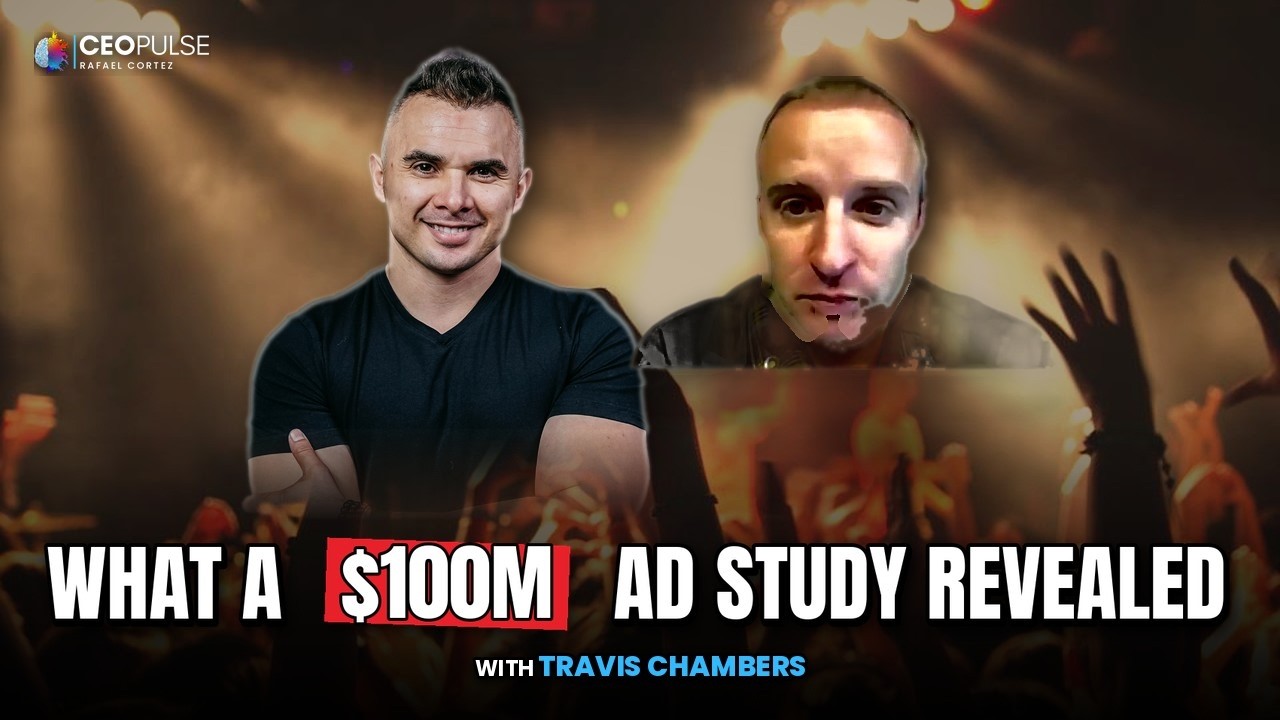
In this CEO Pulse Podcast interview, Rafael Cortez talks with Travis Chambers, founder of the video ad agency Chamber Media. Travis Chambers explains why you should pick an industry instead of a job, how good creative beats ad privacy changes, the foundational video ad types and how much budget you really need to start.
What you will learn in this episode
- Why Travis Chambers says you do not have a job, you have an industry
- How Chamber Media grew from 15 to 120 employees on a four day work week
- Why good creative is the answer to ad privacy changes
- The foundational video ad types from a study of about 50,000 ads
- Why brand recall and emotion drive engagement
- How much marketing budget you need before you run paid ads
How do video ads still work when tracking gets harder?
Who is Travis Chambers?
Rafael Cortez, host of the CEO Pulse Podcast and an Organizational Psychologist, welcomes Travis Chambers, founder of Chamber Media, a growth and video ad agency, who also runs an Airbnb business in the real estate space. Rafael Cortez introduces him as a Forbes 30 under 30 honoree whose agency made the Inc 5000 and who led one of the most viewed ads on YouTube, with about 140 million views.
Travis Chambers says it takes grit, courage and almost enough naivety to start something. Many entrepreneurs he knows went through hard experiences that made them appreciate life more, and most have a bigger driver behind them.
Pick an industry, not a job
The most overlooked skill, Travis Chambers says, is reading an industry. Most people finish high school and think about what job they want, which he calls a horrible approach. Even a doctor can be a family doctor, an eye surgeon or the founder of a company that invents a new medical device. His list of industries he expects to grow includes solar, electric vehicle charging, off grid living, tiny homes, boutique hotels and hospitality experiences, personal aircraft, crypto infrastructure and biomedical devices. Rafael Cortez admits he followed the default path into the fire department and did not start thinking outside the box until his late twenties.
How did Travis Chambers build Chamber Media?
Travis Chambers grew up watching his father, who came from a dairy farm, climb the corporate ladder in marketing at a large agriculture company, often away four or five days a week. He was raised frugally and paid his own way through school, but that exposure to corporate marketing felt like an education of its own. Seeing where his father's long career left him convinced him to do something different.
Working about 70 hours a week with a young daughter, Travis Chambers was let go from 20th Century Fox. He could not find an advertising job with a 40 hour week, so he set out to create one for himself and his team. Chamber Media now has about 120 employees on a four day work week. The agency built for seven years, then grew from 15 to 120 people in about a year and a half.
The slow years first
The first year brought about 800,000 dollars in revenue, which sounds like a lot until it is split between three partners at a 15% profit margin. Rafael Cortez notes that at a 10% margin you are close to flatlining. When people ask Travis Chambers how to start an agency faster, he tells them to put in the years; the five years of building case studies and reputation are what made the later growth possible.
How do you beat ad privacy changes?
Chamber Media spends about 50% on Facebook, 30% on Google and YouTube and 20% on Pinterest and TikTok. Travis Chambers says Facebook works in over two thirds of their industries, while Pinterest skews heavily female and TikTok skews younger. Rafael Cortez asks why ads that work suddenly stop reaching anyone.
Travis Chambers points to the iOS privacy update, after which most people opted out of tracking. That rich targeting data is never coming back, he says, so marketing is returning to broad, interest based targeting, and the answer is good creative: well produced video with a compelling story and a message that grabs attention fast. Of more than 250 accounts, only 4% saw a drop in performance after the update.
The foundational video ad types
Chamber Media studied about 100 million dollars in managed ad spend, tagging thousands of its own ads plus top ads from the top 2,000 Shopify stores, about 50,000 ads in total. The types Travis Chambers names are the spokesperson anchor, which he calls the everything ad, the product demo, social proof such as testimonials, press or reviews, unboxing, lifestyle and dynamic ads built from quick clips. Later he adds the case study ad. The top two ad types differ even between men's and women's apparel, so know which ones win in your industry. The agency built a predictive modeling database it calls the brain and an AI copy tool, Unicorn Copy, so brands can start at base camp instead of guessing.
Why does emotion beat pure information?
Rafael Cortez shares a common frustration: a valuable tutorial gets little engagement, while something that only gets a laugh takes off. Travis Chambers explains that any emotional response creates recall, and brand recall is the most overlooked idea in digital marketing. Before the internet, billboards and TV ads lived on recall alone.
People remember when you relate to them, especially to their pain. Travis Chambers has written thousands of scripts and says that when a script reaches the pain behind a purchase, it sells; even luxury products solve a need to feel important. Rafael Cortez sees the same gap in real estate marketing, where agents push the house and the numbers but rarely the lifestyle for the family moving in.
How do you handle fast growth as a founder?
Growth came from a consequence Travis Chambers could not stomach. At 15 employees, speaking, events and press could not keep revenue steady, and he did not want to lay anyone off. The agency started running its own ads and created lower priced programs so ecommerce brands doing six figures could afford them. Because it already worked with over 50 contractors and sat in a deep Utah film and creative talent pool, it could bring people in house quickly.
As founder, Travis Chambers stayed on sales and hired smart people to run operations without getting in their way. Sales solves all problems, he says. Several who went through that stretch are now executives and partners. Forbes 30 under 30 did little for the business. Direct response clients rarely refer you, because they do not want competitors to know, so Chamber Media published case studies with permission and promised not to take on competing brands. Rafael Cortez agrees that everything comes back to sales.
How much do you need to start running paid ads?
With 10,000 dollars, Travis Chambers says save your money and grow organically on Instagram or TikTok. You also need money for good creative, a ready product and a website that converts. Instead, sell a service and your time, then other people's time, and save until you have 30,000 to 50,000 dollars to take a real shot. If it fails, you still have a service business. Spending seven or eight thousand dollars a month can work, but plan to weather about three months before a positive return.
Advice to his 17 year old self
Travis Chambers would tell his younger self to slow down and take better care of himself, because he was so driven that he hurt himself. Rafael Cortez calls this counterbalance: when he goes all in on a project, conversations, workouts and meditation pull him back. Travis Chambers agrees that hustle is not sustainable and the real word is grit, adding that family is a good counterbalance.
Key takeaways
- Choose an industry. Travis Chambers says reading where an industry is going matters more than picking a job title.
- Creative beats targeting. With tracking data gone, well produced video that holds attention is the way forward.
- Emotion drives recall. People remember ads that relate to their pain or make them feel something.
- Stay in your lane. Travis Chambers kept selling and trusted others to run operations.
- Fund ads properly. Sell your time first and build a real budget before testing paid ads.
Quotes from the conversation
“You don't have a job. You have an industry.”
Travis Chambers, 2:37
“Sales solves all problems.”
Travis Chambers, 31:40
“If you could sell your time, you can sell other people's time.”
Travis Chambers, 38:51
Episode chapters
| 0:00 | Welcome Travis Chambers |
| 2:24 | Pick an industry, not a job |
| 5:38 | From a corporate family to entrepreneur |
| 12:48 | Beating the privacy update with creative |
| 16:38 | The foundational video ad types |
| 23:54 | Emotion, pain and brand recall |
| 27:08 | Growing from 15 to 120 employees |
| 37:28 | How much budget you need |
| 42:16 | Slow down and counterbalance |
Who is on this episode?
Travis Chambers
Travis Chambers is the founder of Chamber Media, a growth and video ad agency, and runs an Airbnb business. He was named to Forbes 30 under 30 and led one of the most viewed ads on YouTube.
About the host: Rafael Cortez
Rafael Cortez is the host of the CEO Pulse Podcast, an Organizational Psychologist and a real estate broker and investor based in Phoenix, Arizona. Raised in Yuma, Arizona, he became one of the youngest firefighters in Yuma County at 19 and launched his first business at 21. He has been involved in more than 1,300 real estate deals since 2009 and mentors entrepreneurs through the L.E.S.S. Business philosophy: Lean, Effective, Strategic, Simple. Rafael is the founder of CEO Pulse, Pulse Realty and Pulse Capital and the creator of REI Pulse CRM, and he mentors wholesalers in group and 1 on 1 settings. Read Rafael Cortez’s full bio.
Questions and answers
Who is Travis Chambers?
Travis Chambers is the founder of Chamber Media, a growth and video ad agency with about 120 employees. He tells Rafael Cortez he also runs an Airbnb business and was named to Forbes 30 under 30.
How do you beat iOS ad privacy changes?
Invest in good creative. Travis Chambers says rich targeting data is not coming back, so well produced video with a compelling story is what holds attention, and only 4% of his agency's accounts dropped after the update.
What are the main types of video ads?
Travis Chambers names the spokesperson anchor, product demo, social proof, unboxing, lifestyle and dynamic ads, plus the case study ad. He says the best types differ by industry.
Why do emotional posts get more engagement?
Any emotional response creates brand recall. Travis Chambers says people remember content that relates to their pain or makes them laugh, so emotion often beats pure information.
How much money do you need to start running paid ads?
More than 10,000 dollars, according to Travis Chambers. He suggests selling a service first and saving 30,000 to 50,000 dollars, and planning to weather about three months before a positive return.
What would Travis Chambers tell his 17 year old self?
Slow down and take better care of yourself. He tells Rafael Cortez he was so driven that he hurt himself, and that grit and counterbalance matter more than nonstop hustle.
Related episodes
Build your business on systems
Rafael Cortez built REI Pulse CRM from the systems he runs his own deals on. See how it works for wholesalers and investors.
Explore REI PulseBrowse every CEO Pulse Podcast episode · About Rafael Cortez · YouTube · Apple Podcasts · Spotify
