
CEO Pulse Podcast | Interview
TL;DR
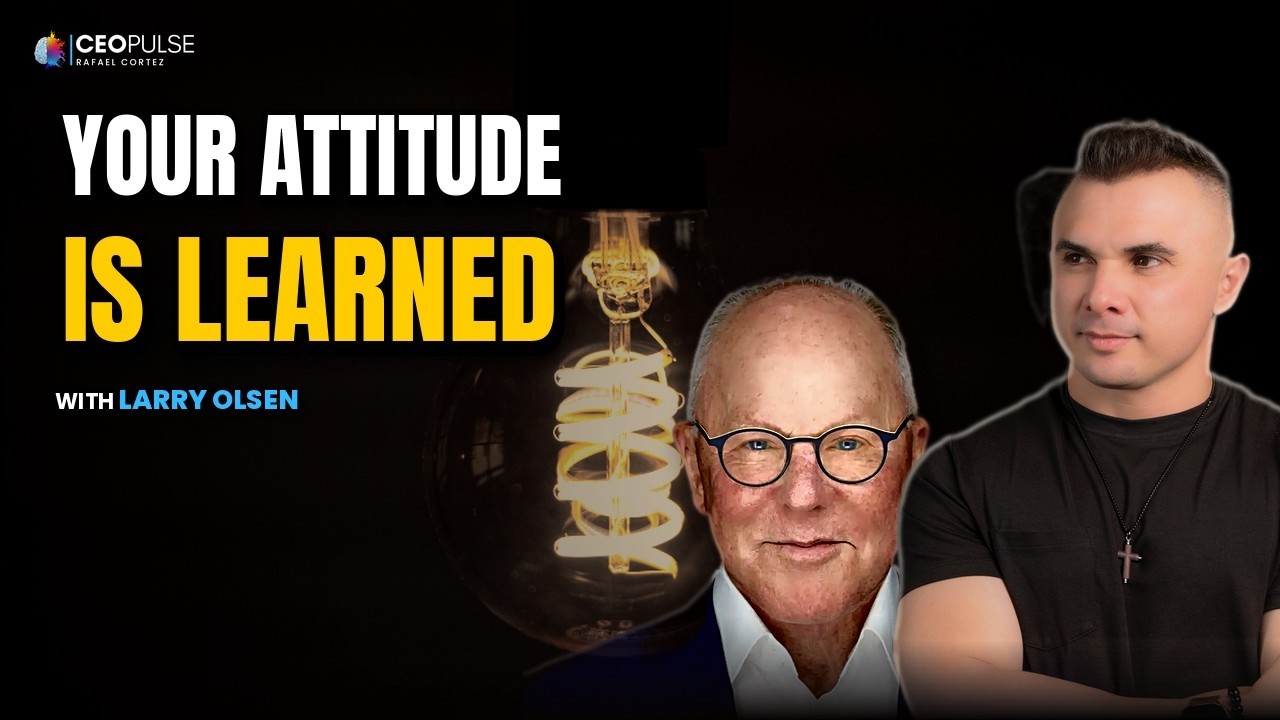
In this CEO Pulse Podcast interview, Rafael Cortez talks with Larry Olsen, author of Get a Vision and Live It, who has worked with Fortune 500 companies on culture building. Larry Olsen explains how attitudes are learned, why leaders quietly cap their people, and how self talk, guiding principles and real delegation align a team with a shared vision.
What you will learn in this episode
- Why attitudes are learned behaviors and not something you are born with
- How leaders make up their minds about people and quietly cap their performance
- How changing your self talk changes your attitudes
- Why guiding principles should be created by the people who live them
- The bedtime question Larry Olsen uses to build self esteem in children
- Why leaders have to hold the space they expect from their teams
How do you align your attitude, and your team, with your vision?
Who is Larry Olsen?
Rafael Cortez, host of the CEO Pulse Podcast and an Organizational Psychologist, welcomes Larry Olsen, author of the book Get a Vision and Live It. Larry Olsen has worked with Fortune 500 companies and focuses on an area Rafael Cortez calls critical yet often overlooked: culture building and the development of high performing people.
Larry Olsen traces his interest to childhood. His older sister learned slowly, and once she was tested, she was given a harsh label that followed her. Seeing how other children treated her, and defending her more than once, made him curious about how much we limit people when we label them. Today, he says, the label has simply become more sophisticated: we call it an attitude.
Where do attitudes come from?
Larry Olsen says nobody is born with attitudes. Attitudes are learned behaviors. He estimates genetics accounts for about 18% of who we are, and the remaining 82% is learned, which is where his work on performance and behavior happens. The brain's job, he explains, is to keep us being the person we see ourselves as, and most people base that picture on what they have experienced rather than what is possible. He believes fewer than 2% of people know how they think; the rest simply think about whatever is on their mind.
Bitten by the snake
Larry Olsen describes the amygdala as the protective part of the brain. If a rustle in the straw once meant a snake bite, the next rustle puts us on alert. In modern life the snakes are overheard conversations, meetings we are not invited to and promotions that go to someone else, and we slip into fight, flight or freeze. After a bad relationship, people judge the next person by the past instead of by who that person is.
How leaders cap their people
Larry Olsen asks how many times someone has to be late before a leader decides they are not punctual. The answer is once. When that person later shows up on time, someone makes a sarcastic remark, and the employee concludes it does not matter whether they are on time. Leaders decide who is capable of what and start treating people accordingly without realizing it. If those people respect the leader, they start to believe it too, and their performance gets capped. Rafael Cortez adds that transparent conversations help, but in most companies they only happen when something needs correcting.
How do you change an attitude?
Larry Olsen says you change your mind the same way it was formed: by how you talk to yourself. In his book he calls this self talk ROX. He pictures a child carrying two buckets up a hill, one for positive experiences and one for negative ones. Every thought drops a rock in a bucket, and whichever side gets heavier is where we lean. By the time a child is 10, he says, they hold over 100,000 attitudes.
Rafael Cortez shares his own example. Being on camera used to scare him, and he is still self conscious about it, yet he chose to push through the barrier instead of waiting to feel comfortable. Larry Olsen's advice is to change the conversation in the moment. Instead of thinking how rude it is that someone arrived five minutes late, ask what might have happened and find out after the meeting. Nine times out of ten, he says, you will be glad you did not ridicule the person in front of others.
Look for what is right in people
Larry Olsen reminds listeners that the odds of being alive at all dwarf the odds of winning the lottery, so life is a gift to be creative with rather than something to suffer through. He cites W. Clement Stone, a 1930s industrialist who called himself an inverse paranoid because he believed the universe was conspiring to do him good. Because the brain looks for evidence to support what it already believes, Larry Olsen recommends deciding up front that everyone you meet is remarkable. When people see that you see more in them than they see in themselves, they want to live up to it, and company performance follows.
Why delegate responsibility instead of tasks?
Rafael Cortez admits that for years he would not release control. While running a transportation and logistics business, he felt he had to manage everything and came close to burnout. Someone told him that he hired people for their talents and skills, so he should let them use them. He started delegating, loosened the rope and found people developing from within the company.
Larry Olsen warns against delegating the trash, meaning only the tasks a leader does not want to do. If you want to build people, which he calls the job of leadership, delegate responsibility and be at peace when it does not go your way. Rafael Cortez believes that when people get something that matters and a chance to show up, they almost always will.
How do guiding principles shape culture?
When Larry Olsen works with a company, he first helps people recognize their own preconceived notions, then leads vision building: the group describes the ultimate organization and lists every reason it would fail. Rather than trying to solve each problem, which only repeats the past, the group asks how people would need to act with one another so those problems could not exist. The answers become the company's values, created by the people instead of an expensive consultant report that nobody reads.
Rafael Cortez uses the same three guiding principles in his personal life and his businesses: radical transparency, extreme ownership and people over profits. He shares how an acquisitions team member at his real estate company was negotiating a deal and could have reworked the terms for roughly $10,000 more in spread. He passed because it was not the best outcome for the seller, and he named the principle out loud. Larry Olsen notes that clear values make decisions easier: if a choice is not in alignment, you do not do it.
What question builds self esteem in children?
Larry Olsen says high performers often do everything for their children yet rarely have time for them. His suggestion is to ask at bedtime, what were you most proud of today? His son was proud of kicking a goal at recess. Remembering that every answer is the next question, Larry Olsen kept asking, and learned his son planned to let a sad friend score the next day. Over time his son spent his days looking for things to be proud of. Larry Olsen suggests adults ask themselves the same question before sleep, focusing on their contribution instead of their deficits.
Rafael Cortez shares that his 14 year old son asked to join his real estate mentorship program after overhearing a student call. Rafael Cortez resisted the urge to micromanage, gave him access to resources and invited him into team meetings and calls. When his son explained procrastination and analysis paralysis back to him, Rafael Cortez realized he had assumed his son only cared about video games. Larry Olsen's own son loved video games and later built a production company in Los Angeles that creates sets for music videos and commercials.
What does it mean for a leader to hold the space?
Larry Olsen points to a study of fourth graders in math: the student whose correct answers were marked improved, while the one with every mistake circled did not. When feedback only targets what is wrong, people stop thinking I did that wrong and start thinking I am wrong. Rafael Cortez says some of the best people in his companies came from difficult backgrounds and turned their lives around once someone believed in them.
Rafael Cortez says a mentor once told him that leadership means holding the space for the people you guide. If he expects radical transparency, extreme ownership and people over profits, he has to live them first. Larry Olsen connects this to the idea of being the change you wish to see. Asked what he would tell his 17 year old self, Larry Olsen answers: pay attention, it is not about you. Make it about everybody else around you.
Key takeaways
- Attitudes are learned. Larry Olsen says most of who we are comes from experience and self talk, so attitudes can be changed.
- Leaders can cap performance. Once a leader makes up their mind about someone, the team member often starts to believe it.
- Delegate responsibility, not trash. Building people is the job of leadership, so give them meaningful ownership.
- Let the team create the values. Guiding principles stick when the people who live them help write them.
- Ask what made them proud. A simple bedtime question trains children and adults to notice their own contributions.
Quotes from the conversation
“Nobody is born with attitudes. Attitudes are learned behaviors.”
Larry Olsen, 2:50
“If you want to build people, which is what the job of leadership is, you gotta delegate responsibility.”
Larry Olsen, 26:19
“Every answer you get is your next question”
Larry Olsen, 33:33
Episode chapters
| 0:00 | Welcome Larry Olsen |
| 1:33 | A sister, a label and a lifelong question |
| 3:52 | How the brain protects old attitudes |
| 6:59 | How leaders cap their people |
| 10:54 | Changing your mind through self talk |
| 17:09 | Seeing everyone as remarkable |
| 24:10 | Delegating responsibility |
| 27:16 | Vision building and guiding principles |
| 31:53 | What were you most proud of today? |
| 46:35 | Holding the space as a leader |
Who is on this episode?
Larry Olsen
Larry Olsen is the author of Get a Vision and Live It and has worked with Fortune 500 companies on culture building and the performance of individuals and teams. His work focuses on how attitudes and self talk shape behavior.
About the host: Rafael Cortez
Rafael Cortez is the host of the CEO Pulse Podcast, an Organizational Psychologist and a real estate broker and investor based in Phoenix, Arizona. Raised in Yuma, Arizona, he became one of the youngest firefighters in Yuma County at 19 and launched his first business at 21. He has been involved in more than 1,300 real estate deals since 2009 and mentors entrepreneurs through the L.E.S.S. Business philosophy: Lean, Effective, Strategic, Simple. Rafael is the founder of CEO Pulse, Pulse Realty and Pulse Capital and the creator of REI Pulse CRM, and he mentors wholesalers in group and 1 on 1 settings. Read Rafael Cortez’s full bio.
Questions and answers
Who is Larry Olsen?
Larry Olsen is the author of Get a Vision and Live It and a culture building expert who has worked with Fortune 500 companies. He joins Rafael Cortez to explain how attitudes shape performance.
Are attitudes learned or inherited?
Larry Olsen says attitudes are learned behaviors. He estimates genetics accounts for about 18% of who we are and the other 82% is learned, which is why attitudes can change.
How do leaders unintentionally limit their employees?
Leaders make up their minds about people quickly and treat them accordingly. Larry Olsen says team members who respect the leader start to believe it, and their performance gets capped.
How do you change a negative attitude about someone?
Change how you talk to yourself about the situation. Larry Olsen suggests replacing judgment with curiosity, such as asking what happened to a late colleague, and deciding up front that people are remarkable.
What guiding principles does Rafael Cortez use?
Rafael Cortez uses radical transparency, extreme ownership and people over profits in both his personal life and his businesses. He says clear principles make decisions simpler for the whole team.
What would Larry Olsen tell his 17 year old self?
Pay attention, it is not about you. Larry Olsen says to make it about everybody else around you.
Related episodes
Build your business on systems
Rafael Cortez built REI Pulse CRM from the systems he runs his own deals on. See how it works for wholesalers and investors.
Explore REI PulseBrowse every CEO Pulse Podcast episode · About Rafael Cortez · YouTube · Apple Podcasts · Spotify
