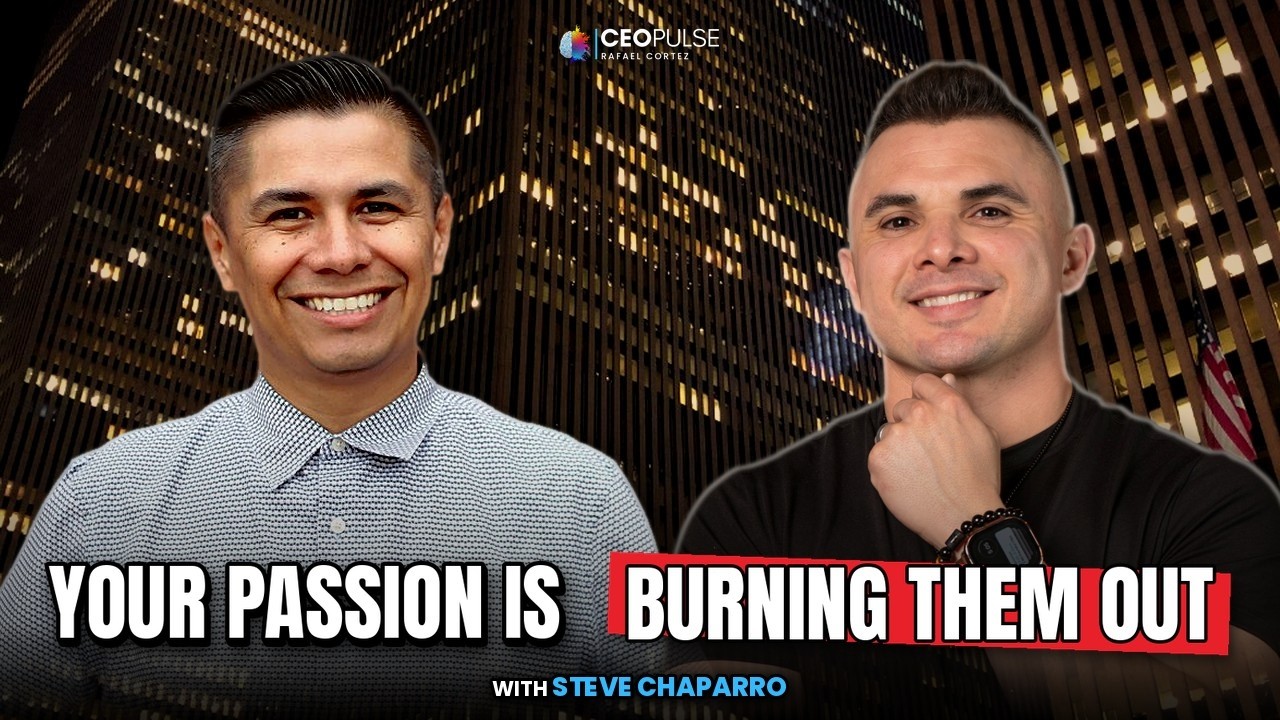

CEO Pulse Podcast | Interview
TL;DR
In this CEO Pulse Podcast interview, Rafael Cortez talks with Steve Chaparro, an organizational culture expert and founder of Culture Design Studio. Steve Chaparro explains why charismatic founders become frustrated visionaries when their ideas meet resistance, why change starts with the leader, and how psychological safety, clear communication and co creation build a vision driven culture.
What you will learn in this episode
- What a frustrated visionary is and why sole genius has a shelf life
- Why change in an organization has to start with the leader
- How to lead a movement instead of issuing a mandate
- The three fears visionaries face at different career stages
- How asking ten people for honest feedback exposed Steve Chaparro's blind spots
- Four pointers for building a vision driven culture
How does visionary frustration break teams, and how do you fix it?
Who is Steve Chaparro?
Rafael Cortez, host of the CEO Pulse Podcast and an Organizational Psychologist, welcomes Steve Chaparro, an organizational culture expert, speaker and founder and principal of Culture Design Studio, who was writing a book on the topic at the time of this conversation. Steve Chaparro earned a five year architecture degree and spent half his career with creative professionals such as architects, designers and marketers. The other half was in business and finance, including real estate development through the housing rise and fall of the 2000s and about three years as a financial advisor. His work sits at the meeting point of business, design and organizational culture.
When sole genius hits its limit
At his last firm, Steve Chaparro saw many charismatic founders whose sole genius launched their early success. As that success started to fade, they realized their genius had a shelf life and that growth would require the collective genius of their team. Many were great communicators from the stage but not across the table when team members pushed back. He points to the innovation adoption curve: trying to get people at the end of that curve to embrace an idea early is hard, if not impossible. He calls himself a frustrated visionary too, and he learned he would have to go through his own transformation before helping others with theirs.
Why does change start with the leader?
When Steve Chaparro became a father, his father in law told him that whenever he wanted his kids to change, he had to change first. The same applies to leaders. If you want your organization to change, ask what you need to do differently. Younger team members will not tolerate top down command and control. They will either speak up or leave.
A movement, not a mandate
Steve Chaparro does not recommend a full overhaul at the start, because people get overwhelmed and walk away. Borrowing from design thinking and the lean startup idea of a minimum viable product, paint a picture of the desired outcome and then take the next best step for a quick win. Small wins and collaboration widen what people are willing to try. Rafael Cortez sums up the difference: a mandate happens because someone said so, while a movement has everyone bought in.
For founders launching something new, Steve Chaparro says to start as the architect of the vision, clear about its purpose, benefits and what it will take. As the company matures, become a facilitator of vision. He describes the spirit, bones and flesh of a movement: the visionary breathes life into the direction, and the team helps shape the structure and what it will look like. Inviting people in takes vulnerability, because you must admit you may not have the best ideas. Rafael Cortez adds that younger generations are often labeled entitled when they really want meaning and to feel that what they do matters.
What fears do visionaries face over a career?
Steve Chaparro sees three. Early in a career, it is the fear of insignificance: I want to matter. Mid career, it is the fear of invisibility: have people noticed my impact? Late in a career, it is the fear of irrelevance, when newer generations ask leaders to show up differently. He has heard leaders in their late fifties wonder whether they have the energy to change or should retire. It is not about changing who they are, he says, but how they show up.
Ten honest answers
Steve Chaparro shares his own story. He was on an executive leadership team and expected to become CEO, and then he was laid off. He wanted to respond with a complaint or legal action, but a friend over coffee told him this was a pattern: he often believed he had better ideas than the people he served under, so he should work on himself. The advice made him sick to his stomach because it was true. He sent ten family members and friends five questions, including what he was good at, what he needed to work on and what strength he took for granted. They told him his passion fires people up but can burn them out, and that he connects ideas quickly but can be condescending to people who need more time. Self awareness, he says, is the foundation of emotional intelligence, and every bright light casts a shadow.
Why is clear communication the leader's job?
Rafael Cortez admits his own default was assuming his team already knew things. His vision was crystal clear in his head but foggy to everyone else, and he assumed team members followed the content he published. Steve Chaparro says entrepreneurs tend to blame the team for not getting it, but the entire burden is on the communicator, and the audience is always right. He recalls the phrase it's not what's taught, it's what's caught. Team members are not content junkies, so leaders have to actually communicate rather than expect people to learn by osmosis.
Steve Chaparro also says people need room to wrestle with the message. When a young leader he mentored complained that his team pushed back on his vision, Steve Chaparro asked whether he had sat down with them one on one. To an insecure leader, processing looks like rebellion; to a secure leader, it is simply processing. When he worked with junior high students, he noticed that even students who mocked a lesson were listening. Pushback also shows you how to communicate differently.
The frustrated visionary defined
A frustrated visionary, Steve Chaparro explains, is a visionary whose passion turns to frustration when their ideas meet resistance. They see not just how the future could look but how it should look. When people give side eye or talk behind the scenes, type A leaders push harder, and frustration can turn into condescension, public humiliation and misplaced anger. If the common thread in 50 difficult conversations is you, the problem is you. He cites a study of CEOs that named frustration, irritation, discouragement and overwhelm as their top negative emotions.
How do you build a vision driven culture?
Steve Chaparro offers four pointers. First, build psychological safety, where people can question and push back without fear of retaliation. Second, sharpen your communication, one on one and one to many, in writing and in body language. Third, invite people into co creation, because the best innovation comes when more voices are at the table. Fourth, practice empathy and social awareness, and invite your team into the visioning process. Rafael Cortez says some of his best innovations came from bringing front line team members into management meetings. He reverse engineers processes, but he looks forward when building culture.
In architecture school, Steve Chaparro was told never to start with the final design already figured out. One line inspires the next, so design is a process of discovery. If social awareness is not your strength, find pullback leaders: in the NFL, some sideline staff are assigned to pull an excited leader back so he does not step onto the field. His advice to his younger self: stick to your guns and pursue your passions instead of letting culture define you. After chasing aspirational goals for 20 years, he found that what he wanted at 15 was right all along.
Key takeaways
- Sole genius has a shelf life. Growth requires the collective genius of your team.
- Change yourself first. Leaders who want their organizations to change must change how they show up.
- Build a movement. Paint the outcome, take small steps and invite people in.
- Ask for honest feedback. Others can show you the shadow side of your strengths.
- Own the message. If your team does not understand, the communicator has to adjust.
Quotes from the conversation
“Whenever I've wanted my kids to change, I needed to change first.”
Steve Chaparro, 5:28
“It's not what's taught, it's what's caught”
Steve Chaparro, 21:44
“It's a visionary whose passion turns to frustration when their ideas meet resistance.”
Steve Chaparro, 26:21
Episode chapters
| 0:00 | Welcome Steve Chaparro |
| 1:32 | The frustrated visionary |
| 4:44 | Change starts with the leader |
| 7:10 | A movement, not a mandate |
| 9:35 | From architect to facilitator of vision |
| 12:44 | Three fears of visionaries |
| 15:05 | Laid off and asking for feedback |
| 21:26 | The burden is on the communicator |
| 29:30 | Building a vision driven culture |
| 36:37 | Advice to his younger self |
Who is on this episode?
Steve Chaparro
Steve Chaparro is an organizational culture expert, speaker and founder and principal of Culture Design Studio. He trained in architecture and worked in real estate development and financial advising before focusing on culture and visionary leadership.
About the host: Rafael Cortez
Rafael Cortez is the host of the CEO Pulse Podcast, an Organizational Psychologist and a real estate broker and investor based in Phoenix, Arizona. Raised in Yuma, Arizona, he became one of the youngest firefighters in Yuma County at 19 and launched his first business at 21. He has been involved in more than 1,300 real estate deals since 2009 and mentors entrepreneurs through the L.E.S.S. Business philosophy: Lean, Effective, Strategic, Simple. Rafael is the founder of CEO Pulse, Pulse Realty and Pulse Capital and the creator of REI Pulse CRM, and he mentors wholesalers in group and 1 on 1 settings. Read Rafael Cortez’s full bio.
Questions and answers
Who is Steve Chaparro?
Steve Chaparro is an organizational culture expert and founder of Culture Design Studio. He tells Rafael Cortez his background spans architecture, real estate development and finance.
What is a frustrated visionary?
Steve Chaparro defines it as a visionary whose passion turns to frustration when their ideas meet resistance. That frustration can show up as condescension or misplaced anger.
Why does organizational change start with the leader?
Steve Chaparro says leaders who want their teams to change must first change how they show up. Younger team members will speak up or leave under top down control.
What three fears do visionaries face?
Insignificance early in a career, invisibility mid career and irrelevance late in a career. Steve Chaparro says the answer is changing how you show up, not who you are.
How do you build a vision driven culture?
Steve Chaparro recommends psychological safety, strong communication, co creation and empathy. He also suggests inviting the team into the visioning process.
What would Steve Chaparro tell his younger self?
Stick to your guns and pursue your passions instead of letting culture define you. Steve Chaparro says he came back to what he wanted at 15 and is happier for it.
Related episodes
Build your business on systems
Rafael Cortez built REI Pulse CRM from the systems he runs his own deals on. See how it works for wholesalers and investors.
Explore REI PulseBrowse every CEO Pulse Podcast episode · About Rafael Cortez · YouTube · Apple Podcasts · Spotify
