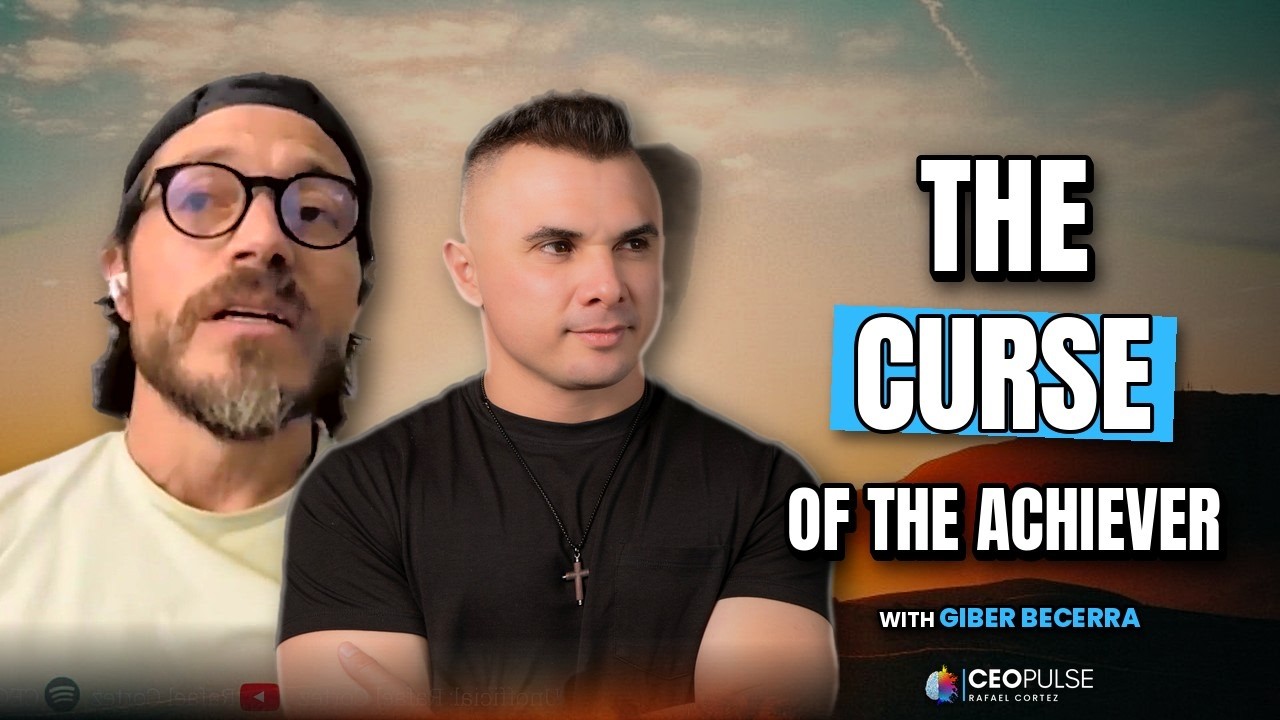

CEO Pulse Podcast | Interview
TL;DR
In this CEO Pulse Podcast interview, Rafael Cortez talks with Giber Becerra, the high performance specialist who worked with the Mexican national soccer team at the 2014 World Cup in Brazil. Giber Becerra explains why the process matters more than the result and how responsibility, small daily habits, mental models and a clear identity drive elite performance.
What you will learn in this episode
- Why Giber Becerra focuses on the journey instead of the result
- How taking 100% responsibility changes your life
- Why small daily habits compound into big results
- How Giber Becerra wrote down the 2014 World Cup more than a decade before it happened
- How mental models and inversion shape better decisions
- Why you should become the person who could achieve your biggest goal
What does high performance look like for athletes and entrepreneurs?
Who is Giber Becerra?
Rafael Cortez, host of the CEO Pulse Podcast and an Organizational Psychologist, welcomes Giber Becerra, a high performance specialist from his hometown whom Rafael Cortez calls a living legend back home. Giber Becerra worked with the Mexican men's national soccer team at the 2014 World Cup in Brazil and with Club America, one of the top teams in Mexico. His work goes beyond physical conditioning into the mental side of performance.
Giber Becerra says he is still becoming who he is. He likes Nick Saban's focus on the process: winning is rewarding, but the feeling lasts only a few hours before you look to what is next, the curse of the achiever. For him, the journey is where it is at, with its falls, sweat and scars, both physical and emotional.
How do you stay grounded under pressure?
Working in a highly visible, high stakes environment, Giber Becerra has received a lot of media and social media attention, much of it positive and some of it critical. He says success can fog your brain into thinking you know it all, and the moment you buy into that story, growth stops. A friend in Mexican media once described a visitor from Peru who was in awe just being inside a stadium. Giber Becerra tries never to lose that sense of awe. Every time he walks into a stadium, he remembers watching games on television and wishing he could get close enough to smell the grass.
Rafael Cortez says many people grow bitter because they do not have the money, car or title yet. Giber Becerra's advice is to keep fighting for what you want while working with what you have right now.
Why take 100% responsibility?
Giber Becerra says to take 100% responsibility and be the CEO of your life. To be likable, you have to like yourself, and to love others you have to love yourself first. Everyone has issues and a dark side; the choice is to look in the mirror and act, or to hide from yourself. Rafael Cortez shares that responsibility felt like a burden at first, because if things went right or wrong it was on him, yet that awareness is what lets you change your habits and environment. Within about six months of sticking with new habits, he says, even your thought process changes.
Both recommend Extreme Ownership by Jocko Willink; Giber Becerra buys Spanish copies for his team. They also discuss Carol Dweck's Mindset: a fixed mindset stunts growth, while a growth mindset says I got this wrong today, but with patience and persistence I can improve.
Why do small habits beat big bursts?
Giber Becerra says social media shows only highlights, never the years behind them, and today's culture of instant gratification makes patience harder, especially for kids. He references the marshmallow experiment on delayed gratification. Reading ten pages or ten minutes a day is not sexy, but by the end of a year you will have read 10 or 15 books instead of zero. Small habits like that are easy to do and easy not to do, and over time they compound. He points to Atomic Habits by James Clear and the compound effect.
Rafael Cortez says attrition happens when people start new habits, so simplify: ask whether something is good for your life or not. The conversation also turns to morning routines: moving from waking up without a plan to a set routine, where skipping it makes the rest of the day feel off. Giber Becerra adds that you must give any new practice enough time to work, at least a few months, and find what works for you rather than copying someone else. Methods change, but principles such as responsibility and the compound effect do not.
How did Giber Becerra reach the World Cup?
Giber Becerra grew up curious, searching for his place in the world without many role models. Books became his way to meet new people and travel, since his family could not afford much. Reading Andrew Carnegie, Seneca and Marcus Aurelius, he noticed the same ideas appearing across centuries and began collecting mental models into his own philosophy. From Poor Charlie's Almanack by Charlie Munger he took inversion: study what makes people miserable, then do the opposite. He chose to take care of himself physically, mentally and emotionally, and to believe the universe was conspiring in his favor.
Twelve to fourteen years before it happened, he wrote down that he would be at the 2014 World Cup. When he stood on the field in the Mexican national team jersey during the national anthem, with his family watching at home, he cried. That moment, he says, made everything worth it.
Who do you need to become?
Years ago Giber Becerra met Gary Vaynerchuk, who talked about wanting to buy the New York Jets. The lesson was the question behind it: who do I have to become to be that person? Giber Becerra jokes that he wants a private jet he does not need, because it forces him to grow into the person who could buy one. There is no final destination; each summit reveals the next mountain. His why, inspired by Simon Sinek's Start With Why, is to find the best version of himself so he can serve others, and no one else gets to set that ceiling.
He says identity drives behavior. If you see yourself as average, you act that way; if you see yourself as someone who makes things happen, you live it before others see it. He points to David Goggins as an example of reinventing yourself, and says he is grateful for his older self but does not need him anymore. He sees young players reach the first team and stop growing, while greats like Serena Williams kept evolving.
Associations and mentors who do not have to be alive
Rafael Cortez says thinking big requires associating with people at that level, and his masterminds feel like a think tank. Giber Becerra adds that books let you associate with the greatest minds. He imagines asking advice from a personal council of figures such as Einstein and Tesla. Those are your friends, he says, and they do not have to be alive.
What would Giber Becerra tell his 17 year old self?
Giber Becerra would tell his younger self to know when to be patient and when to be impatient, and to focus on what he can control, a lesson he ties to Stoic philosophy and the serenity prayer. He embraces criticism and laughs at it. He hopes his own children face some hard situations, because that is how people grow. He closes with Marcus Aurelius and the idea of memento mori: remembering that life is short is a reason to do the work every day and get 1% better.
Key takeaways
- Love the process. Wins fade in hours; the journey is where growth happens.
- Be the CEO of your life. Taking 100% responsibility is the first step to real change.
- Small habits compound. Ten pages a day turns into 10 or 15 books a year.
- Write it down. Giber Becerra wrote down the 2014 World Cup more than a decade before he got there.
- Become the person first. Ask who you need to become to reach your biggest goal.
Quotes from the conversation
“Take 100% responsibility, be the CEO of your life, first and foremost”
Giber Becerra, 13:48
“It's boring, but it's easy to do and it's easy not to do”
Giber Becerra, 25:06
“Those are your friends, they don't have to be alive.”
Giber Becerra, 1:15:53
Episode chapters
| 0:00 | Welcome Giber Becerra |
| 3:04 | The process over the result |
| 7:57 | Staying in awe and staying grounded |
| 13:43 | Be the CEO of your life |
| 19:55 | Growth mindset and patience |
| 24:51 | Small habits and the compound effect |
| 29:42 | Books, role models and mental models |
| 47:40 | Writing down the World Cup |
| 50:46 | Who do you need to become? |
| 1:29:15 | Patience, control and advice to his younger self |
Who is on this episode?
Giber Becerra
Giber Becerra is a high performance specialist who worked with the Mexican men's national soccer team at the 2014 World Cup in Brazil and with Club America. He focuses on the physical and mental sides of elite performance.
About the host: Rafael Cortez
Rafael Cortez is the host of the CEO Pulse Podcast, an Organizational Psychologist and a real estate broker and investor based in Phoenix, Arizona. Raised in Yuma, Arizona, he became one of the youngest firefighters in Yuma County at 19 and launched his first business at 21. He has been involved in more than 1,300 real estate deals since 2009 and mentors entrepreneurs through the L.E.S.S. Business philosophy: Lean, Effective, Strategic, Simple. Rafael is the founder of CEO Pulse, Pulse Realty and Pulse Capital and the creator of REI Pulse CRM, and he mentors wholesalers in group and 1 on 1 settings. Read Rafael Cortez’s full bio.
Questions and answers
Who is Giber Becerra?
Giber Becerra is a high performance specialist who worked with the Mexican national soccer team at the 2014 World Cup and with Club America. He talks with Rafael Cortez about mindset, habits and growth.
What does it mean to be the CEO of your life?
Giber Becerra says it means taking 100% responsibility for your results instead of blaming others. Rafael Cortez adds that this awareness is what makes lasting change possible.
Why do small habits matter so much?
Giber Becerra says small habits are easy to do and easy to skip, but they compound over time. Reading ten pages a day adds up to 10 or 15 books a year.
How did Giber Becerra get to the World Cup?
Giber Becerra wrote down that he would be at the 2014 World Cup roughly 12 to 14 years before it happened. He built toward it through reading, self care and a belief that life was working in his favor.
What is inversion as a mental model?
Inversion means studying what leads to a bad outcome and then doing the opposite. Giber Becerra learned it from Charlie Munger and used it to shape his own path.
What would Giber Becerra tell his 17 year old self?
Giber Becerra would say to know when to be patient and when to be impatient, and to focus on what you can control. He also embraces hard moments as the way people grow.
Related episodes
Build your business on systems
Rafael Cortez built REI Pulse CRM from the systems he runs his own deals on. See how it works for wholesalers and investors.
Explore REI PulseBrowse every CEO Pulse Podcast episode · About Rafael Cortez · YouTube · Apple Podcasts · Spotify
