
CEO Pulse Podcast | Interview
TL;DR
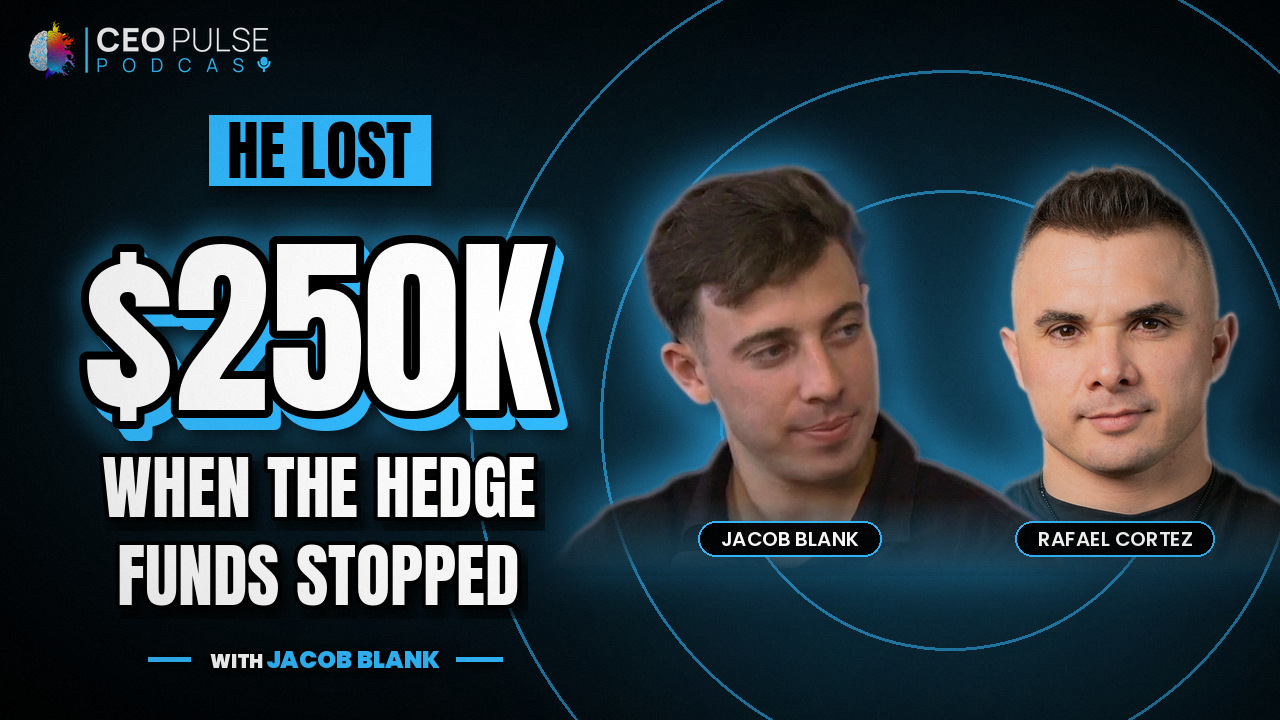
In EP 257 of the CEO Pulse Podcast, part of the REI Bigshots collaboration, Rafael Cortez and Vic Heredia talk with Jacob Blank, who found wholesaling at 16, waited eight months for his first deal, and grew a cold calling team to just under $1.8 million in a single year. He explains the hedge fund buy box that paid him about $100,000 a month, the quarter million he lost from July to the end of the year when those buyers stopped, and how buying deeper and getting back on the phones kept him in business.
What you will learn in this episode
- Why Jacob Blank says most money in wholesaling is made with speed
- How a canceled first contract and a $30,000 Scottsdale deal two months later shaped his drive
- How he went from flyers and bandit signs to cold calling and hired his first two callers with $5,000
- How the business grew from $120,000 in its first year to just under $1.8 million
- How a hedge fund buy box worked and why it stopped
- What to do when the business is bleeding money for more than a couple of months
- Why commitment, focus and consistency matter more than any single tactic
What do Rafael Cortez and Jacob Blank cover in this episode?
Who is Jacob Blank?
Jacob Blank opens the episode by saying everybody is trying to get out of the rat race and that finding a way to succeed is not easy. It took him eight months to get his first deal, and his heart was broken along the way. The REI Bigshots host says he met Jacob when Jacob was 17 and already doing deals.
Jacob says he was always entrepreneurial. Before real estate he was flipping junk on OfferUp and getting people to give him their stuff. He liked money and he saved it. His view is that most money is made with speed: you have to chase it down, and without tenacity and drive you are not going to be successful. Today what drives him is taking care of his mom and his sister.
Why did a student deal mean more to him than his biggest assignment?
Jacob says helping students succeed has become more fulfilling than his own deals. One student he had been working with for a little over a year just closed an $85,000 deal. His own biggest deal was a $210,000 assignment fee on a house in Los Angeles, sold to Wedgwood, a hedge fund. He says he felt about 10 times better about the student’s $85,000 deal than about his own $210,000.
How did Jacob Blank get started in wholesaling?
He found out about wholesaling at 16 from YouTube and spent about a month building a journal and a game plan. His first marketing was flyers printed on printer paper, about 500 of them to a pre foreclosure list, and he got no calls. Next came a few hundred bandit signs, which he put up with a ladder, and about five calls.
Then he found cold calling. He pulled a list of homeowners who had lived in their homes for 15 years or more and dialed for four hours a day. With $5,000 he had saved, he hired two cold callers. Today his team uses a different dialer, and he says the one he is testing brings in about double the leads.
What happened with his first contract and his first closed deal?
About six months in, he got his first contract on a house on a golf course in Gilbert. When the buyer walked the property, he found foundation problems with a $13,000 repair bid, and the deal was canceled. Jacob says it destroyed him. Two months later he closed his first deal in Scottsdale and made $30,000. At 17 he was also walking into pre foreclosures on his own, including one in El Mirage where people were using drugs inside.
Rafael Cortez shares his own start: he studied a wholesaling course for two to three months and got his first deal in 10 days, helped by about 20 years in sales. Both agree that you have to be committed to keep going even after you fall on the ground 10 times.
What did his daily routine look like as a teenager?
Jacob got mono in his sophomore year of high school and switched to online school. He finished his schoolwork by about 10 in the morning and called sellers until 4 or 5 in the afternoon. His goal was 500 dials and at least four hours on the phone every day. One rule stuck with him from the start: make everybody you talk to an offer, no matter what.
How did Jacob Blank scale to just under $1.8 million a year?
After the $30,000 deal, he spent $25,000 of it on mentorship. He kept adding callers, from 2 to 4, 6, 8 and up to about 20. The business did $120,000 by the end of his first year, then just under $600,000, then $800,000, then $1.3 million and then just under $1.8 million. He says he does about $1 million a year now.
He rented a 500 square foot office for $1,500 a month, ran leads through Podio and handled acquisitions himself for about a year and a half. A disposition hire did not work out, and he now has a full time dispositions person and works deals nationwide. His team today is three acquisitions reps, one dispositions person and 22 callers, plus PPC.
How did the hedge fund buy box change his business?
Through a connection, Jacob learned the buy boxes that hedge funds were using. He built a sheet with every hedge fund buy box and put it in front of every sales rep with one instruction: lock up anything $40,000 below Zillow that meets this box. He says they made $400,000 in under two months and averaged about $180,000 a month, spending $60,000 to $70,000 a month and taking home about $100,000 a month. In July 2022 he had 25 to 28 deals on the board. He calls it the gold rush.
How did he lose a quarter million dollars?
When the hedge funds stopped buying, his overhead of $60,000 to $70,000 a month kept going. From July to the end of the year he lost a quarter million dollars, with about 34 people on his team in Mexico and nine in the US. His lesson is that they were too slow to shift. When the business is bleeding a lot for more than a couple of months, he says, you need to pivot instantly.
He cut four or five people a week and eventually let almost everyone go, keeping his three core team members, his office and the infrastructure he would need if the buyers came back. He was 19 or 20 at the time. Because he had saved his money, he could absorb the loss while much of the industry went out of business. His rule for small businesses is simple: stay in business, do not go out of business.
What pivot kept his business alive?
He cut marketing from 33 callers to eight, put all his old leads back into the dialer to rewarm them, went after JV leads and created a brand called Hedge Fund Cash Buyer to get deals from other wholesalers. For four or five months they did no more than two deals a month. The strategy, he says, was to buy deeper, go back to regular wholesaling, remind his longtime sales reps how hard deals were in 2019 and 2020, and lead from the front by getting back on the phones himself.
He also brought in marketers who would run digital ads on a split and built strategic partnerships. Facebook worked for a while but feels saturated to him now, and he thinks Google PPC is the better strategy. His main channel is still cold calling. Rafael Cortez agrees: pick one channel you know well as the anchor and treat everything else as a bolt on.
How did he handle the pressure and the risk of burnout?
Jacob describes an identity crisis after the losses. When you are winning you feel you will never lose, and when you are losing you feel you will never win again, but neither is true. He drowned out the noise by calling sellers. At the same time he was dealing with a legal issue that cost about $20,000 a month while supporting his mom and his sister, so he had to make money no matter what.
Eventually he started handing off tasks to his team because the stress was not sustainable. Rafael Cortez talks about going through burnout in his mid twenties and how it makes you lose sight of what matters.
What does Jacob Blank say it takes to succeed?
His first key is commitment: a promise you make to yourself that you are going to make it happen no matter what, and then keep. His second is focus combined with consistency. Too many people split their time between drop shipping, crypto, day trading and wholesaling. Show up every day, 365 days a year, he says, and a year from now you will be a different person.
His advice to his 17 year old self is that he would not change anything, but he would tell himself not to trust everybody, because business is war. His book picks are Secrets of the Millionaire Mind and Traction. Listeners can find him at JacobBlank.com, which links to all his socials.
Key takeaways
- Speed makes money. Jacob Blank says most money in wholesaling is made by chasing opportunities fast.
- Make every seller an offer. From day one he tried to make an offer to everybody he spoke to.
- Scale with callers. Two callers hired with $5,000 grew to about 20 and just under $1.8 million in a year.
- Know your buyers. A sheet of hedge fund buy boxes and a $40,000 below Zillow rule paid about $100,000 a month while it lasted.
- Pivot fast when you bleed. Waiting too long when buyers stopped cost him a quarter million dollars.
- Stay in business. Savings, a core team and his office let him survive while much of the industry closed.
- Commit and stay consistent. A promise to yourself, focus and daily work beat any shortcut.
Quotes from the conversation
“It took me eight months to get my first deal. My heart was broken.”
Jacob Blank, 0:04
“Most money is made with speed.”
Jacob Blank, 4:17
“I felt way better about his $85,000 deal than when I made $210,000, probably like 10 times better.”
Jacob Blank, 9:01
“You lock up anything $40,000 below Zillow that meets this box.”
Jacob Blank, 29:36
“Stay in business, don’t go out of business.”
Jacob Blank, 35:25
“It’s like this promise you make to yourself that you’re gonna make it happen no matter what.”
Jacob Blank, 46:37
Episode chapters
| 0:00 | Eight months to his first deal |
| 0:29 | Meet Jacob Blank |
| 1:17 | Flipping junk on OfferUp |
| 5:23 | Why money stopped being enough |
| 8:34 | The student deal that paid $85K |
| 9:19 | He started wholesaling at 16 |
| 13:34 | The first deal that broke his heart |
| 21:15 | Mono, online school and 500 dials a day |
| 23:42 | Scaling to $1.8 million a year |
| 28:10 | Inside the hedge fund gold rush |
| 31:12 | How he lost a quarter million |
| 35:58 | The pivot that saved his business |
| 40:32 | The lead source working right now |
| 42:59 | Pressure, family and burnout |
| 46:39 | His formula: commitment, focus and consistency |
| 51:03 | What he would tell his 17 year old self |
| 53:07 | Where to find Jacob |
Who is on this episode?
Jacob Blank
Jacob Blank is a real estate wholesaler who found wholesaling at 16 and closed his first deal in Scottsdale after eight months of trying. He built a cold calling team that grew to about 20 callers and did just under $1.8 million in a single year, survived the end of the hedge fund buying wave, and now works deals nationwide with acquisitions, dispositions and calling teams. He also mentors students. Find him at JacobBlank.com.
About the host: Rafael Cortez
Rafael Cortez is the host of the CEO Pulse Podcast, an Organizational Psychologist and a real estate broker and investor based in Phoenix, Arizona. Raised in Yuma, Arizona, he became one of the youngest firefighters in Yuma County at 19 and launched his first business at 21. He has been involved in more than 1,300 real estate deals since 2009 and mentors entrepreneurs through the L.E.S.S. Business philosophy: Lean, Effective, Strategic, Simple. Rafael is the founder of CEO Pulse, Pulse Realty and Pulse Capital and the creator of REI Pulse CRM, and he mentors wholesalers in group and 1 on 1 settings. Read Rafael Cortez’s full bio.
Vic Heredia
Vic Heredia is a co host of REI Bigshots and joins Rafael Cortez for this episode.
Questions and answers
Who is Jacob Blank on the CEO Pulse Podcast?
Jacob Blank is the guest on EP 257, part of the REI Bigshots collaboration with Rafael Cortez and Vic Heredia. He is a real estate wholesaler who started at 16 and built a cold calling team.
How long did it take Jacob Blank to get his first deal?
Eight months. His first contract, on a house in Gilbert, was canceled over foundation problems, and two months later he closed a deal in Scottsdale and made $30,000.
What marketing did he try first?
About 500 printer paper flyers to a pre foreclosure list, which brought no calls, then a few hundred bandit signs, which brought about five calls. Cold calling is what worked.
How fast did his business grow?
He did $120,000 by the end of his first year, then just under $600,000, $800,000, $1.3 million and just under $1.8 million. He says he does about $1 million a year now.
What was the hedge fund buy box strategy?
He gave every sales rep a sheet of hedge fund buy boxes and told them to lock up anything $40,000 below Zillow that fit. He says it brought in about $180,000 a month on average.
How much did he lose when the hedge funds stopped buying?
About a quarter million dollars from July to the end of the year, with about 34 people on his team in Mexico and nine in the US.
What did he do to survive?
He cut callers from 33 to eight, rewarmed old leads, chased JV deals through a brand called Hedge Fund Cash Buyer, bought deeper and got back on the phones himself.
What lead source does he like now?
Cold calling is still his main channel. He thinks Google PPC is a better strategy than Facebook, which feels saturated to him.
What is his biggest assignment fee?
A $210,000 assignment fee on a house in Los Angeles, sold to a hedge fund. He says a student’s $85,000 deal felt about 10 times better.
What are his keys to success?
Commitment, a promise to yourself that you will make it happen no matter what, plus focus and consistency every day.
What books does Jacob Blank recommend?
Secrets of the Millionaire Mind and Traction.
Where can listeners find Jacob Blank?
At JacobBlank.com, which links to all of his social accounts.
Related episodes
Try REI Pulse free for 15 days
Rafael Cortez built REI Pulse from the systems he runs his own deals on. Start a 15 day free trial and see how it works for wholesalers and investors.
Start the 15 day free trialBrowse every CEO Pulse Podcast episode · About Rafael Cortez · YouTube · Apple Podcasts · Spotify
