
CEO Pulse Podcast | Interview
TL;DR
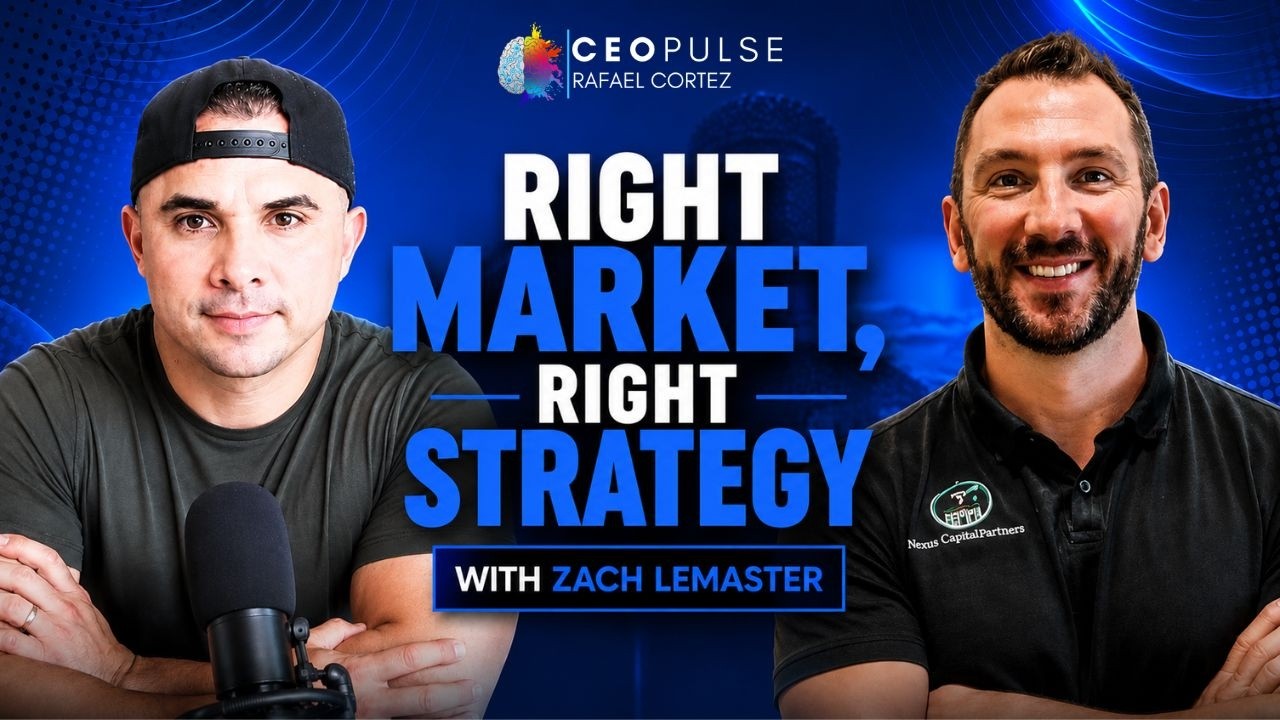
In EP 240 of the CEO Pulse Podcast, host Rafael Cortez talks with Zach Lemaster, CEO and owner of Rent to Retirement and a former U.S. Air Force captain and optometrist, about turnkey real estate: choosing markets by supply and demand, new construction rentals with local teams, managing risk, the IDEAL investment and why consistency builds wealth.
What you will learn in this episode
- How Zach Lemaster went from Air Force captain and optometrist to full time real estate investor
- Why Zach says true wealth is built through buy and hold real estate
- What turnkey investing means at Rent to Retirement
- The macro and micro criteria Zach uses to choose markets
- How to manage risk and emotion with the IDEAL investment framework
- Why Zach says it is never too late to start investing in real estate
How does Zach Lemaster pick the right market and strategy?
Who is Zach Lemaster?
Rafael Cortez introduces Zach Lemaster as the CEO and owner of Rent to Retirement, a turnkey investment company that builds new rental homes and manages them for investors. Zach got into real estate in 2011, while the market was still recovering from 2008 and 2009.
Zach tells Rafael that he and his wife are both optometrists who spent eight years in professional school. He had a scholarship and was commissioned in the U.S. Air Force as a captain. After the military he owned a private practice before retiring from it because of real estate. They still practice optometry on a volunteer basis, including setting up cataract clinics in developing countries, and Zach says real estate gave them the time and financial position to have that larger impact. Real estate, he says, is where he found a true passion and was able to engineer the lifestyle he wanted.
Rafael Cortez adds that one of his mentors once told him there are many ways to play in real estate, and that beyond the money, it can bring passion and fulfillment if you play your cards right.
Why does Zach Lemaster say buy and hold builds true wealth?
Zach Lemaster says many people come to real estate for financial independence: retiring a spouse, cutting back hours or diversifying. There are a thousand ways to invest, and many, like flipping and wholesaling, are active jobs. Those are businesses that produce one time income. In Zach's view, true wealth is built through buy and hold real estate: owning property in good areas with good teams over time, which creates consistent passive income.
Rafael Cortez mentions a study from a large lender showing that a big share of upper and middle income households still put their assets in real estate, because people feel comfortable with a tangible asset. Zach agrees that real estate is the most predictable path to wealth. His own research on wealthy people found that most people worth between $1 million and $10 million built their wealth largely through real estate, while above $10 million business ownership becomes more prevalent, though real estate is still a strong part of their assets.
How did Zach Lemaster get started in real estate?
Asked what triggered the shift from a steady career, Zach Lemaster says his path was like most people's. He wanted to be savvy with money but never understood stocks. Real estate was tangible and easy to understand, and he loved leverage: you borrow from a bank to own an asset you control, receive the income and tax benefits, and the tenant pays the loan off. He listened to podcasts and read books, including Robert Kiyosaki's.
Zach's first property was a duplex bought with a VA loan while he was in the military. He put no money down, lived in one half and rented the other, which covered his mortgage. He says there has not been a single year since that he did not buy more real estate. Not every deal made money, but staying consistent built a portfolio that let him and his wife retire from their careers.
Rafael Cortez notes how a single book can plant a seed with ripple effects for generations, mentioning that Robert Allen, the no money down author, is in a mastermind with him.
What is turnkey real estate investing?
Zach Lemaster clarifies that Rent to Retirement does not lease homes to investors; it leases homes for investors, who own the asset while the company handles management. Turnkey is a buzzword that is often poorly defined, Zach says. To his company, it means identifying the best locations in the country, building local teams and systems there and offering newly built, cash flow positive rentals that anyone can buy regardless of experience, location or how active they want to be.
Many of Zach's investors have W2 careers. They want to own real estate without buying themselves another job, and many live in expensive markets where the numbers do not work. Zach's advice is to be an intentional investor and focus on locations that fit your goals.
How do you choose the right real estate market?
Zach Lemaster explains why he started investing out of state. He was stationed in North Dakota, where he bought his first duplex and the next few rentals. It was an okay cash flow market with little appreciation and low population growth. When he and his wife began investing in markets with more affordability, higher demand, better rents and better appreciation, Zach says it changed the trajectory of their lives and business.
What macro factors matter most?
Over a decade, Zach Lemaster's team built a systematic approach that largely comes down to supply and demand. He sees a big population shift to the Southeast and says the U.S. has a shortage of about 7.2 million homes. Because of the affordability crisis, they target areas below the national median price, which he puts at roughly $400,000, where a brand new four bedroom home costs $200,000 to $400,000 and rents high enough for positive cash flow. They also look for job growth, a diversity of industries, landlord friendly laws and low taxes. Zach's company works heavily in the Sunbelt, including Texas, Georgia, Florida, the Carolinas and Alabama.
What micro factors matter within a market?
Within a market, Zach Lemaster focuses on where job growth and transportation are heading; his team even attends city planning meetings. The most overlooked factor, he says, is the local team. He likes secondary markets: Orlando is expensive and heavily regulated, but Polk County areas like Poinciana, about 30 minutes away, cost a fraction as much while rents stay high.
Rafael Cortez uses a similar filter in his own business, treating areas with populations under about 300,000 as a cue to dig deeper. He says the people he mentors often struggle most with choosing which new market to enter. Zach adds that remote work has let people live where it is more affordable, so following affordability trends creates opportunity, especially in growing secondary markets where housing infrastructure has not caught up.
What does a turnkey company's team look like?
Zach Lemaster says Rent to Retirement has a core team of about 20 people and partners with local builders and property managers that it vets thoroughly. In each new area, the first thing they do is buy their own portfolio to test the team. They also line up lenders, insurance providers and real estate attorneys and CPAs.
The goal, Zach says, is not to sell a property and say good luck. It is to map out a plan, such as how many properties it takes to reach $10,000 a month in passive income, using tools like home equity lines or self directed IRAs. He mentions local credit unions that allow investment purchases with as little as 5 percent down. The real secret, Zach says, is not a secret: good locations, good teams and time. Last year his company did just over 700 homes across 12 to 13 markets.
How do you manage risk as a real estate investor?
Rafael Cortez says instant gratification hurts entrepreneurs, because new builds and financing take time and markets shift, as interest rates did. Zach Lemaster says investing is all about mitigating risk while being willing to take it. The biggest risk he sees for investors is not doing anything: reading the book but never applying it.
You can mitigate risk through education, the right partnerships and a plan, Zach says. Construction has faced interest rate, supply chain, labor and inflation challenges, but his company stays consistent by spreading across markets and sticking to fundamentals: growth, demand, appreciation, rising rents and positive cash flow from day one. New construction avoids surprise maintenance that can wipe out years of cash flow on older homes. Zach says sales have held steady because his investors understand you can still make good deals today, arguably better than in a hot market.
What is the IDEAL investment?
Asked how he handles the emotional side, Zach Lemaster says you need emotional intelligence and faith in the numbers. Many new investors look only at cash on cash return or cash flow. Zach's team calls real estate the IDEAL investment: I is income, or cash flow; D is depreciation and tax benefits; E is equity buildup as the tenant pays down the loan; A is appreciation, since real estate rises over time despite short term swings; and L is leverage, used strategically to stretch your capital. Understanding the numbers over many years, not just year one, tempers emotion.
Zach adds that real estate takes work and grit, unlike handing money to a stock broker, but it is the best path to wealth if you stay the course. Deals will go south and tenants will need to be evicted. There is always a solution, he says, so learn the lesson and apply it to a better deal. Rafael Cortez agrees that many people only think three or six months ahead and jump ship when ripples hit.
What advice would Zach Lemaster give his 17 year old self?
Answering Rafael Cortez's signature question, Zach Lemaster says he would tell himself to be more conscious of his actions. He was money oriented even in college, doing rent arbitrage on rooms under a master lease. He spent about $400,000 on a doctorate he now uses only as a volunteer, and he says he might have accomplished more by going straight into business and real estate, though he notes that is not the right choice for everyone.
Zach's key takeaway: it's never too late to start investing in real estate. With the right strategy, a few years of dedicated, intentional investing can change your life. Rafael Cortez adds that people overestimate what they can do in a month and underestimate what they can do in a year.
Key takeaways
- Buy and hold builds wealth. Zach Lemaster says flipping and wholesaling are jobs; holding property in good areas creates lasting wealth.
- Choose markets by supply and demand. Look for population growth, housing shortages, affordability, job diversity and landlord friendly laws.
- Secondary markets can beat big cities. Areas near major metros often cost far less while rents stay strong.
- The local team is the overlooked factor. Zach's company buys its own portfolio in a new area before offering it to investors.
- Not investing is the biggest risk. Mitigate risk through education, partnerships and a plan, then act.
- Think IDEAL, not just cash flow. Income, depreciation, equity, appreciation and leverage all build wealth over time.
- Consistency wins. Zach has bought real estate every year since his first VA loan duplex.
Quotes from the conversation
“Consistency is the key to success in this game.”
Zach Lemaster, 0:16
“True wealth is built through buy and hold real estate”
Zach Lemaster, 3:49
“The biggest risk that I see is not doing anything”
Zach Lemaster, 21:42
“It's never too late to start investing in real estate”
Zach Lemaster, 30:13
Episode chapters
| 0:00 | Real estate takes work, and introducing Zach Lemaster |
| 1:39 | From Air Force captain and optometrist to investor |
| 5:23 | The most predictable path to wealth |
| 6:25 | Making the leap and the first VA loan duplex |
| 9:42 | How the turnkey model works |
| 11:52 | Investing out of state and choosing markets |
| 16:48 | Remote work and affordability trends |
| 18:11 | Building local teams and an investment plan |
| 20:04 | Instant gratification, risk and fundamentals |
| 24:55 | Emotion, the IDEAL investment and staying the course |
Who is on this episode?
Zach Lemaster
Zach Lemaster is the CEO and owner of Rent to Retirement, a turnkey real estate company that builds and manages new construction rentals for investors in markets across the country. He and his wife are both optometrists, and he served as a captain in the U.S. Air Force before building a real estate portfolio that let them retire from practice.
About the host: Rafael Cortez
Rafael Cortez is the host of the CEO Pulse Podcast, an Organizational Psychologist and a real estate broker and investor based in Phoenix, Arizona. Raised in Yuma, Arizona, he became one of the youngest firefighters in Yuma County at 19 and launched his first business at 21. He has been involved in more than 1,300 real estate deals since 2009 and teaches the L.E.S.S. Business philosophy: Lean, Effective, Strategic, Simple. Rafael is the founder of CEO Pulse, Pulse Realty and Pulse Capital and the creator of REI Pulse CRM, and he mentors wholesalers in group and 1 on 1 settings. Read Rafael Cortez’s full bio.
Questions and answers
Who is Zach Lemaster?
Zach Lemaster is the CEO and owner of Rent to Retirement, a turnkey real estate investment company. He is a former U.S. Air Force captain and optometrist who started investing in real estate in 2011.
What is turnkey real estate investing?
At Rent to Retirement, turnkey means the company finds strong markets, builds new rentals, places tenants and manages the homes while the investor owns them. Zach Lemaster says it lets people invest regardless of experience or where they live.
Why does Zach Lemaster prefer buy and hold real estate?
He says flipping and wholesaling are active jobs that create one time income. Zach Lemaster tells Rafael Cortez that true wealth is built by holding real estate in good areas with good teams over time.
How did Zach Lemaster buy his first rental property?
He bought a duplex with a VA loan while serving in the Air Force, put no money down and rented the other half. Zach Lemaster says the rent covered his mortgage, and he has bought real estate every year since.
How do you pick a good real estate market?
Zach Lemaster looks at supply and demand: population growth, housing shortages, affordability, job growth, industry diversity, landlord friendly laws and low taxes. Within a market, he studies job growth, transportation and the quality of local teams.
Why invest in secondary markets?
Secondary markets can offer lower prices with strong rents. Zach Lemaster gives Polk County near Orlando as an example, and Rafael Cortez uses populations under about 300,000 as a cue to dig deeper.
How big is the U.S. housing shortage?
Zach Lemaster says the U.S. is short about 7.2 million homes. He adds that remote work has pushed people toward more affordable areas, increasing demand there.
What is the biggest risk for real estate investors?
Not doing anything at all. Zach Lemaster says you can mitigate risk through education, the right partnerships and a clear plan.
Why does Rent to Retirement focus on new construction?
Zach Lemaster says new homes avoid unforeseen maintenance that can wipe out years of cash flow on older properties. Combined with growing markets, that sets investors up for long term success.
What is the IDEAL investment?
It is Zach Lemaster's acronym for how real estate builds wealth: income, depreciation, equity buildup, appreciation and leverage. He says understanding all five over time helps investors keep emotion out of decisions.
How many homes does Rent to Retirement sell a year?
Zach Lemaster says the company did just over 700 last year across 12 to 13 markets. He says sales have stayed steady because investors still find good deals.
What advice would Zach Lemaster give his 17 year old self?
Be more conscious of his actions and start in business and real estate sooner. Zach Lemaster also tells Rafael Cortez that it is never too late to start investing.
Related episodes
Build your business on systems
Rafael Cortez built REI Pulse CRM from the systems he runs his own deals on. See how it works for wholesalers and investors.
Explore REI PulseBrowse every CEO Pulse Podcast episode · About Rafael Cortez · YouTube · Apple Podcasts · Spotify
