
CEO Pulse Podcast | Interview
TL;DR
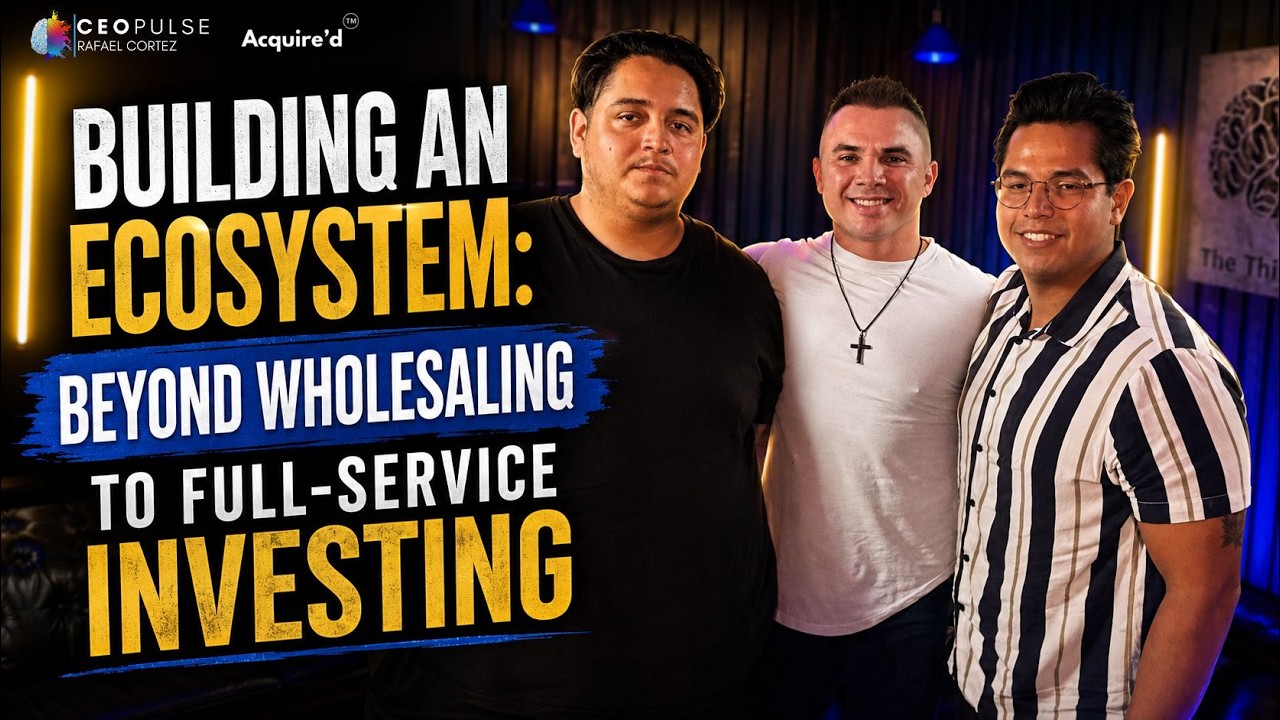
In EP 237 of the CEO Pulse Podcast, host Rafael Cortez talks with Miguel Rivera and Rudy Gomez, cofounders of Acquired, about growing a Los Angeles wholesale company into a real estate ecosystem. They cover systems, buying deals with their own money, working with agents, team flips, hiring, accountability and finding a mentor.
What you will learn in this episode
- How Miguel Rivera and Rudy Gomez run acquisitions and dispositions like an assembly line
- Why the Los Angeles market changes street by street and zip by zip
- How Acquired buys and briefly holds deals instead of assigning contracts
- Why about 80 percent of their deals come from real estate agents
- What they learned about hiring, firing and accountability as founders
- Why Rafael Cortez and both guests say to find a mentor and learn from people already doing it
How did Miguel and Rudy build a real estate ecosystem beyond wholesaling?
Who are Miguel Rivera and Rudy Gomez?
Miguel Rivera and Rudy Gomez are the cofounders of Acquired, a California real estate investment company with offices in Beverly Hills and Costa Mesa. Rafael Cortez introduces them as rock stars working one of the toughest markets in the country. He says they launched Acquired in 2024, closed about $129 million in volume last year and are on track for roughly $300 million in sales and more than $6 million in assignments and wholesale revenue this year. Rafael met them through a mutual friend named Jesus.
Both founders were born and raised in Los Angeles and met at a larger corporate wholesale company, where one would bring deals and the other would handle much of the dispositions. At the time of the interview they were 24 and 26 years old. Rafael uses that to make a point to listeners: you do not have to wait until your 30s or 40s to build something big if you are hungry.
Rafael opens the episode with a reminder he repeats later. Building a company like this does not happen by magic. There will be hustle, tenacity, great moments, tough moments and moments where you question everything. That, he says, is the entrepreneur path.
How do systems help Acquired scale?
When Rafael asks how they hit the ground running, the answer is teamwork and framework. In the beginning the two founders tried to be the transaction coordinator, the closer and the prospector all at once. They were doing big deals but not volume. Adding a strong transaction coordinator and separating the acquisitions and dispositions teams changed that. Once the flow was set, it worked like an assembly line, and the dispositions team could focus only on selling deals once they were shipped over.
Rafael agrees that systems are not the exciting part of a business but they are the magic behind repeatable success. He breaks his own companies into lanes, such as acquisitions, fulfillment and measurement, and says each lane needs segmentation and accountability. He admits he used to think keeping parts of the picture away from his dispositions side was a bad thing, because he wanted everyone to see the whole business. He learned that clear lanes reduce confusion and let people own one job and crush it, which builds their identity and confidence.
Why does knowing your own market matter in Los Angeles?
Growing up in LA gave them market familiarity. They say out of state wholesalers often treat LA like one big city, but every pocket and zip code is priced differently. One of them used to take a different route to work every day just to learn the city better. Near their office on Wilshire, north of the boulevard you find single family homes and south of it you find condos, duplexes and triplexes, all in the same zip code. If you do not know that, you can badly miss your comps and offers.
They also explain that top agents in LA farm a few zip codes instead of working the whole county, so the real job is figuring out who controls the inventory in each pocket and building relationships with them. About 55 percent of their deals are in LA County, Orange County is second and the Bay Area is third, with about 12 Bay Area deals in a single month.
Rafael, who runs a nationwide wholesale model, says you learn fast that moving one street over can mean a completely different price point. He adds that even with AI and automation getting all the attention, belly to belly relationships with sellers and buyers will never grow old. The goal is to become the person an agent calls first.
How does the Acquired wholesale model work?
Acquired does not mainly assign contracts. They close on properties with their own money, hold them for a day to a few days and then resell them. They say this builds the brand because every purchase shows up in the public record, while an assignment leaves no paper trail. Agents see the purchases and call with the next deal, which happens almost every day.
They say about 80 percent of their deals come from agents or contacts who work with agents. Agents often get a stake, such as extra points or half of the assignment fee, so they have a reason to bring deals. California also allows dual representation, so the founders sometimes let the listing agent write their offer even though they are licensed themselves, because it can help the offer get accepted.
That model keeps overhead low. They point to operators spending $100,000 a month on paid ads to make $300,000, which trims their margin every month. Rafael adds that outbound channels like texting and ringless voicemail can stop working overnight, while relationships with strong agents are one of the most reliable things you can build. Anyone can send a text blast, he says, but it is much harder to become the investor an agent calls first in their pocket.
Why did Acquired add flips, escrow and staging?
Most of their deals are still wholesale, but they started flipping after watching investors make far more on houses they had sold. They recall a dinner celebrating a large assignment fee when they ran the numbers and realized the buyer would make several times that by flipping the house in a few months. Now, on clean deals, they ask whether they would rather make $20,000 to $30,000 or $70,000 to $150,000 by flipping. Flipping also wins deals from agents who do not want to work with wholesalers.
They also run team flips. On one house in Compton, eight team members each put in $10,000 and split the profit evenly. They say it helps with retention, gets the team excited and lets people start building wealth in a state where investing usually takes six figures.
Looking ahead, their goal for next year is about $20 million in gross revenue from roughly 400 deals and at least 120 flips. They plan to open in the Bay Area, San Diego and central California before other states. They had just launched an escrow company and have a staging company in the works, alongside a brokerage, so investors at any stage can use them as a one stop shop. Rafael says controlling several stages of the same deal lets a company earn at multiple levels while making life easier for clients.
How did Miguel and Rudy get into real estate?
One of the founders started at 16 shadowing agents at open houses and cold calling, and before that he detailed cars door to door as a teenager. The other was selling shoes when a customer handed him Rich Dad Poor Dad. He got his license, interned at Keller Williams at 17, worked at Berkshire Hathaway and left the industry after two years because being a retail agent was hard. He came back when he discovered the investment side, which clicked for him. One of them also sold windows and doors door to door at 16 and says it thickened his skin.
Rafael notes that they reinvested in the business instead of spending on luxuries after their first deals. They say investing in the team comes first, including bringing the team to events. Rafael also shares that one of his mentors told him there are many ways to play in real estate, and you do not have to love the transactional side to win in the space.
What did they learn about hiring and accountability?
Their top lesson is hire fast and fire fast. Early on they hired almost anyone and even pitched friends to join, which was not the right fit. They say hiring more people sooner would have taught them faster. Now expectations are clear, and someone who stops showing up does not last. As founders who work around 14 hours a day, letting people slide was hurting their own mental health. Rafael says that leaves you carrying weight that is not yours.
Rafael describes three principles that guide his businesses: radical transparency, extreme ownership and people over profits. When a leader operates that way, he says, the team starts to mirror those values. The founders add that a business can only grow as much as its people grow, and that the person earning $100,000 is not the same person who earns $500,000 or a million.
They recall a dinner with one of the largest luxury brokers in LA County, who asked what separates a multimillion dollar company from a billion dollar one. They answered culture. He said culture means nothing without accountability. They also learned they cannot be upset with someone for breaking rules nobody explained, so they set clear expectations and a visible roadmap. On the acquisitions side, a key metric is writing 20 offers a week, because it is trackable and within anyone's control.
How do Miguel and Rudy keep growing as leaders?
They say the biggest thing is getting to know people personally and studying what makes each person tick. Small things like remembering birthdays, taking people out and friendly challenges, such as $100 to whoever books the first meeting, go a long way. They have invested more than six figures in their own education through mentorship, programs and one on one calls, and they are not afraid to ask for help from people already doing what they want to do.
They add that some of the wealthiest investors they meet are the humblest, while ego often shows up in people doing a couple of deals. Rafael says the mastermind effect changed his own path. He grew up in a Hispanic household where the instinct was to guard everything so others would not take your ideas. Once he realized there is plenty for everyone and started asking questions openly, his growth sped up.
What advice do they give new entrepreneurs?
Miguel says he would do it the same way again: find whoever is crushing it and go work for them, even for free or a low split, and get really good. There is so much information available that you are not going to reinvent how to flip a house. Rudy adds that free events are everywhere, and that you should find someone doing what you want to do and get under their wing, because business owners are looking for hungry people.
Rafael says that is how he started in wholesaling. After selling another business, he went to work for Sean Terry to learn from someone who had it dialed in. He tells listeners who say they are too tired after work that you have to work on your own dream after hours while you build know how and relationships during the day.
The founders also describe the LA market as one dominated by agents, where even direct to seller deals often use the standard California Association of Realtors form. They say helping buyers tell the difference between a winning and a losing deal builds loyalty for life and has paid off long term. For their 17 year old selves, one founder says to give yourself more credit and turn your disadvantages into advantages, and the other says to surround yourself with the right people.
Key takeaways
- Systems create volume. Miguel Rivera and Rudy Gomez split acquisitions, dispositions and transaction coordination so deals move like an assembly line.
- Know every pocket of your market. In Los Angeles, one street can change the property type and price, so local knowledge protects your comps and offers.
- Agents can be a deal engine. About 80 percent of Acquired deals come from agents, who share in the fee and see their purchases in public records.
- Hire fast, fire fast. Clear expectations and accountability matter more than culture events, the founders tell Rafael Cortez.
- Track what you control. Writing 20 offers a week is a simple, trackable target for acquisitions reps.
- Learn from people already winning. Miguel, Rudy and Rafael all say to find a mentor and work under someone who has the business dialed in.
Quotes from the conversation
“Because stories like this and in case studies like this don't happen overnight.”
Rafael Cortez, 21:18
“Like learn from whoever's really crushing it. Go work for them.”
Miguel Rivera, 38:51
“Find a mentor because those people are looking for hungry people.”
Rudy Gomez, 40:05
Episode chapters
| 0:00 | It does not begin by magic, and meeting the Acquired founders |
| 2:18 | Teamwork, framework and the assembly line |
| 4:08 | Why they chose the Los Angeles market |
| 9:31 | Adding flips and team flips |
| 14:10 | Building an ecosystem with escrow, staging and brokerage |
| 16:04 | How Miguel and Rudy got into real estate |
| 21:27 | Buying with their own money and working with agents |
| 26:54 | Hiring, firing and accountability |
| 33:49 | Personal growth, education and asking for help |
| 38:27 | Advice for new entrepreneurs and their younger selves |
Who is on this episode?
Miguel & Rudy
Miguel Rivera and Rudy Gomez are the cofounders of Acquired, a California real estate investment company launched in 2024 with offices in Beverly Hills and Costa Mesa. Both were born and raised in Los Angeles, came up through real estate sales and wholesaling, and now run wholesale, flips, brokerage and escrow under one roof.
About the host: Rafael Cortez
Rafael Cortez is the host of the CEO Pulse Podcast, an Organizational Psychologist and a real estate broker and investor based in Phoenix, Arizona. Raised in Yuma, Arizona, he became one of the youngest firefighters in Yuma County at 19 and launched his first business at 21. He has been involved in more than 1,300 real estate deals since 2009 and teaches the L.E.S.S. Business philosophy: Lean, Effective, Strategic, Simple. Rafael is the founder of CEO Pulse, Pulse Realty and Pulse Capital and the creator of REI Pulse CRM, and he mentors wholesalers in group and 1 on 1 settings. Read Rafael Cortez’s full bio.
Questions and answers
Who are Miguel Rivera and Rudy Gomez?
Miguel Rivera and Rudy Gomez are the cofounders of Acquired, a California real estate investment company with offices in Beverly Hills and Costa Mesa. Both grew up in Los Angeles and met at a larger wholesale company before launching Acquired in 2024.
What is a real estate investing ecosystem?
It is one company covering several stages of a deal. Miguel and Rudy describe Acquired as wholesale, flips, a brokerage, a new escrow company and a staging company in the works. Rafael Cortez says that lets a company earn at multiple levels while making life easier for investors.
How is the Acquired model different from typical wholesaling?
Instead of assigning contracts, Acquired closes with its own money, holds the property for about a day to a few days and resells it. Miguel and Rudy say each purchase shows up in public records, which builds their brand and brings agents calling with new deals.
Where do Miguel and Rudy get most of their deals?
About 80 percent come from real estate agents or contacts who work with agents. Agents often earn extra points or half of the assignment fee, which gives them a reason to bring deals. Miguel and Rudy say this keeps overhead lower than heavy paid advertising.
Why does local market knowledge matter in Los Angeles?
Miguel and Rudy say every pocket and zip code in LA is priced differently, and one street can separate single family homes from multifamily. Without that knowledge, investors can miss their comps and offers. Rafael Cortez says nationwide wholesalers learn this fast.
What are team flips?
Team flips are flips funded by several team members together. Miguel and Rudy describe one in Compton where eight people each put in $10,000 and split the profit evenly. They say it helps retention and lets team members start building wealth.
When should a wholesaler start flipping houses?
Miguel and Rudy started flipping after watching buyers make far more on houses they had wholesaled. On clean deals, they now compare a $20,000 to $30,000 assignment against $70,000 to $150,000 from a flip. Flipping also helps them win deals from agents who avoid wholesalers.
What did Miguel and Rudy learn about hiring?
Their biggest lesson is to hire fast and fire fast, and to be very clear about expectations. Early on they hired almost anyone, which was not the right fit. Rafael Cortez adds that letting people slide leaves leaders carrying weight that is not theirs.
What principles does Rafael Cortez use to lead his businesses?
Rafael Cortez describes three principles: radical transparency, extreme ownership and people over profits. He says when a leader operates that way, the team starts to mirror those values and ethics.
Why is accountability more important than culture?
Miguel and Rudy recall a top LA luxury broker telling them that culture means nothing without accountability. You can host every event you want, but people still need to show up and do what they say they will do.
What KPI do Miguel and Rudy set for acquisitions reps?
A key target is writing 20 offers a week. Miguel and Rudy say it is simple, trackable and within anyone's control, and they keep their KPIs simplified so people stick to them every week.
How should a new entrepreneur get started in real estate?
Miguel Rivera says to find whoever is crushing it and go work for them, even for free or a low split. Rudy Gomez says to find a mentor doing what you want to do, because business owners are looking for hungry people. Rafael Cortez started wholesaling by working for Sean Terry.
What advice would Miguel and Rudy give their 17 year old selves?
When Rafael Cortez asks Miguel and Rudy this question, one would tell his younger self to give himself more credit and turn his disadvantages into advantages. The other would say to surround yourself with the right people, because they influence your habits and conversations.
Related episodes
Build your business on systems
Rafael Cortez built REI Pulse CRM from the systems he runs his own deals on. See how it works for wholesalers and investors.
Explore REI PulseBrowse every CEO Pulse Podcast episode · About Rafael Cortez · YouTube · Apple Podcasts · Spotify
