
CEO Pulse Podcast | Mindset Monday
TL;DR
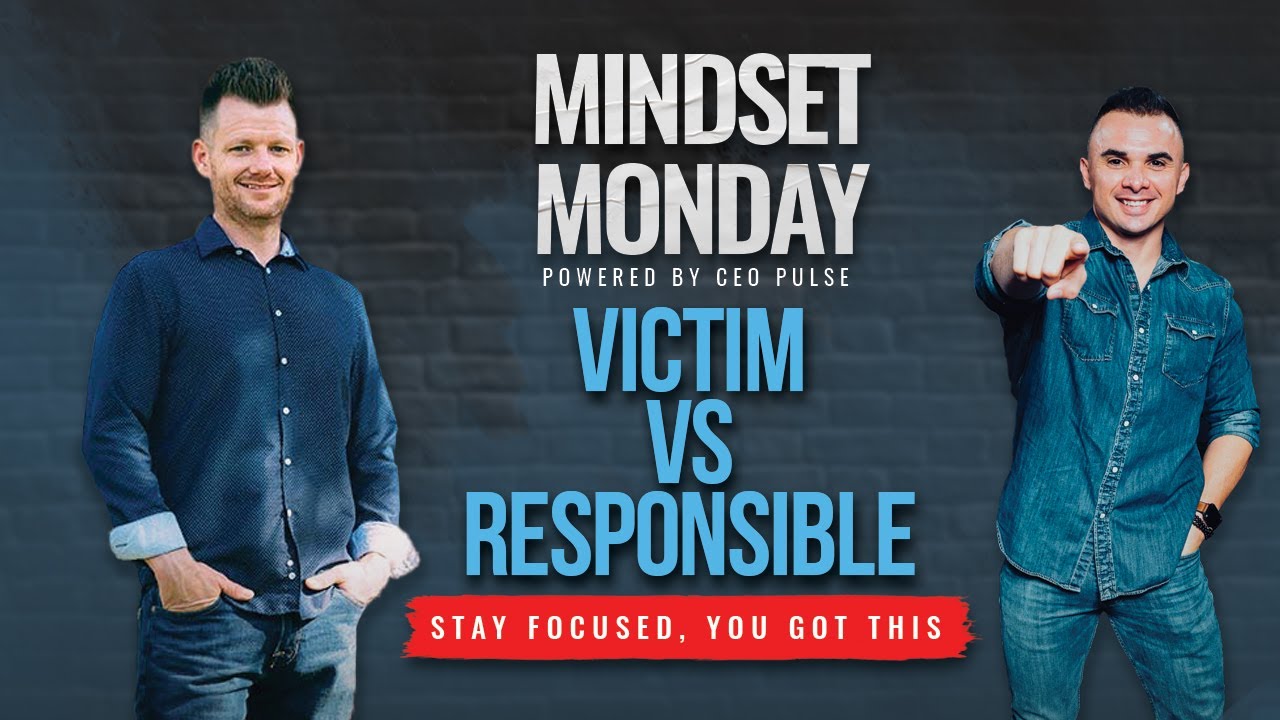
In this Mindset Monday episode, Rafael Cortez and co host Justin Thorstad compare victim consciousness with a responsible mentality. They explain responsibility as the ability to respond, the 1 percent ownership question, reaction versus response, extreme ownership, why your past does not determine your future, and how taking ownership makes entrepreneurs resourceful.
What you will learn in this episode
- The difference between victim consciousness and a responsible mentality
- Why responsibility means the ability to respond, not blame
- The 1 percent question that leads to full ownership
- How reaction differs from response in emotional moments
- How extreme ownership applies to teams, markets and everyday frustrations
- Why ownership makes you resourceful when money or skills seem missing
How do entrepreneurs move from victim to responsible mentality?
What is victim consciousness?
Rafael Cortez, host of the CEO Pulse Podcast and an Organizational Psychologist, opens this Mindset Monday episode with co host Justin Thorstad and a question about default reactions: when situations come at you, do you respond from responsibility or fall back into being a victim?
Justin Thorstad defines victim consciousness as a lens that says it is not my fault, I am powerless and I am not a creator. Conditions, circumstances and environment run the show. The market, the team or someone else is always the cause of failure or lack of success.
What does responsibility really mean?
On the other end of the spectrum is responsibility. Justin Thorstad is clear that he does not mean fault or blame. He breaks the word down into response ability, the ability to respond. Whether it is your business, your marriage or your kids, he suggests one simple question whenever you want to point a finger: where is my 1 percent responsibility in this?
If you are willing to own 1 percent, he says, it leads to 2 percent, then 10 percent, and soon full ownership of the result. That is exciting news, because if it is you, you have the full ability to change everything. A victim, by definition, is powerless to transform the situation.
What is the difference between a reaction and a response?
Rafael Cortez adds emotional responsibility. It does not matter what caused the situation. What matters is whether you react or respond, because those come from two different places. He references the viral moment at that year's Academy Awards as a clear example of a reaction to a trigger. The point, he says, is to give yourself a little space to ask whether you are acting from ego or actually processing what happened.
Justin Thorstad connects this to a previous episode on fear: fear is a reaction, but courage is a decision. A reaction is a habit that fires in an instant. Taking a moment to ask how you want to respond, and what the highest and best outcome would be, is the responsible path.
How does responsibility apply to changing markets?
Justin Thorstad uses the real estate market as an example. Markets are cyclical. They go up, sideways and down. He is careful to say he is not predicting a crash or giving financial advice, only that the environment will change like the seasons.
When money is easy, many people simply spend more. A responsible response is to reinvest, build savings and cash reserves, and be ready to adjust. He remembers the downturn around 2006 and 2007, when many people left the business blaming the market. Others adapted by shifting to short sales and bank owned properties. As one host puts it, you have to adjust your sails when the winds shift.
What is extreme ownership?
Rafael Cortez says one of the principles in his companies is extreme ownership, which he borrowed from the book by Jocko Willink. For his team it means more than owning your task list. It includes emotional intelligence and going above and beyond to help improve someone else's lane.
It also applies to small moments. If someone cuts you off on the freeway, you can stay sour for 30 minutes or take ownership of your emotional space, wish them well and move on. Rafael Cortez admits he has walked away from a messed up fast food order feeling salty for 15 minutes. His advice is to either have the conversation or let it go, but do not carry it home.
Justin Thorstad shares how he applies ownership as a leader. When he sees profit dip in his real estate team or brokerage, his first instinct might be that the agents need to sell more. He quickly catches himself and says it is me, because leaders create results through others. Pointing the finger gets you nowhere, and the hosts agree it actually makes things worse.
Does your past determine your future?
Rafael Cortez says a victim story usually reaches into the past to justify the present or even the future. His answer is that our past does not determine our future. You can make a cut in time right now and decide where you want to go from there.
Justin Thorstad agrees and says that is how you become a conscious creator of your reality instead of a spectator. Victims are in the stands heckling and pointing fingers; creators get on the field, take action and own the results, including mistakes. Rafael Cortez adds a favorite reminder: ego is not your amigo. Ego can push you to react or to give up, and Justin Thorstad describes it as a bundle of unobserved thoughts that loses its grip once you shine a light on it.
Rafael Cortez also notices an energetic side to this. When he slips into victimhood, small annoyances seem to pile on and the day spirals down. When he keeps his personal power and leaves the bad vibe outside his space, things tend to line up. Justin Thorstad calls it the law of polarity: if you can spiral down, you can also spiral up, and anything you practice you can master.
Justin Thorstad also notes, gently, that everyone carries hard experiences from childhood, and that what matters is how each person internalized them. Those experiences are real, but they do not have to decide what you do next.
How does ownership make you resourceful?
Rafael Cortez explains that everyone has different thresholds, emotional, financial and social, for what they can handle. Someone who had a hard childhood may handle much more than someone hit by real life for the first time. Either way, moving forward comes down to tenacity.
Justin Thorstad says ownership makes you resourceful, one of the most valuable skills there is. When someone says they cannot start a business because they do not have the money, he asks who said it had to be their money. You can raise capital, borrow or partner up. Every problem, by definition, has a solution.
Rafael Cortez adds that consistency and persistence eventually lead you to the right person, resource or tool. Justin Thorstad says he never feels like a failure because, to him, failure is only not getting started or quitting. Rafael Cortez closes with a line from The Hangover: but did you die? Once you accept your worst fear as a possibility, you are no longer its hostage.
Key takeaways
- Responsibility is response ability. Justin Thorstad says it is not fault or blame but your ability to respond.
- Start with 1 percent. Asking where your 1 percent responsibility lies leads step by step to full ownership.
- Respond, do not react. Rafael Cortez says a few seconds of space can turn an ego reaction into a thoughtful response.
- Leaders own the result. When profits dip, Justin Thorstad looks in the mirror first, because leaders create results through others.
- Ownership creates resourcefulness. Partners, capital and tools appear when you stop waiting for perfect conditions.
Quotes from the conversation
“Where's my 1% responsibility in this?”
Justin Thorstad, 2:17
“Fear is a reaction but courage is a decision”
Justin Thorstad, 5:47
“Our past does not determine our future.”
Rafael Cortez, 17:50
“Not getting started or quitting.”
Justin Thorstad, 28:14
Episode chapters
| 0:46 | Victim versus responsible defined |
| 1:34 | Response ability and the 1 percent question |
| 3:55 | Reaction versus response |
| 5:29 | Fear is a reaction, courage is a decision |
| 6:18 | Markets are cyclical |
| 8:42 | Extreme ownership |
| 10:16 | Leaders own the results |
| 17:14 | Your past does not determine your future |
| 22:46 | Thresholds and tenacity |
| 25:06 | Becoming resourceful |
Who is on this episode?
Justin Thorstad
Justin Thorstad is the co host of the CEO Pulse Podcast Mindset Monday episodes. He runs a real estate brokerage and leads seminars and masterminds on mindset and business structure for entrepreneurs.
About the host: Rafael Cortez
Rafael Cortez is the host of the CEO Pulse Podcast, an Organizational Psychologist and a real estate broker and investor based in Phoenix, Arizona. Raised in Yuma, Arizona, he became one of the youngest firefighters in Yuma County at 19 and launched his first business at 21. He has been involved in more than 1,300 real estate deals since 2009 and mentors entrepreneurs through the L.E.S.S. Business philosophy: Lean, Effective, Strategic, Simple. Rafael is the founder of CEO Pulse, Pulse Realty and Pulse Capital and the creator of REI Pulse CRM, and he mentors wholesalers in group and 1 on 1 settings. Read Rafael Cortez’s full bio.
Questions and answers
What is victim mentality?
Justin Thorstad defines victim consciousness as believing it is not my fault and that you are powerless. Conditions, circumstances and other people are seen as the cause of every setback.
What does responsibility mean in a responsible mentality?
Justin Thorstad breaks the word into response ability, the ability to respond. It is not about fault or blame but about owning how you show up.
What is the 1 percent responsibility question?
Justin Thorstad suggests asking where your 1 percent responsibility is whenever you want to blame someone. Owning that small part leads to more ownership and more power to change the result.
What is the difference between reacting and responding?
Rafael Cortez says a reaction is an instant, often ego driven trigger, while a response comes after a moment of processing. Giving yourself a few seconds of space is emotional responsibility.
What is extreme ownership in business?
Rafael Cortez uses extreme ownership, from the book by Jocko Willink, as a company principle. It means owning your tasks, your emotions and even helping improve other people's lanes.
How does a responsible mentality help new entrepreneurs?
Justin Thorstad says ownership makes you resourceful, so lack of money or skills becomes a problem to solve. You can raise capital, borrow or partner up instead of waiting.
Related episodes
Build your business on systems
Rafael Cortez built REI Pulse CRM from the systems he runs his own deals on. See how it works for wholesalers and investors.
Explore REI PulseBrowse every CEO Pulse Podcast episode · About Rafael Cortez · YouTube · Apple Podcasts · Spotify
