
CEO Pulse Podcast | Interview
TL;DR
In this CEO Pulse Podcast interview, Rafael Cortez talks with Chris Miles, the anti financial advisor and founder of Money Ripples. He explains why entrepreneurs should control risk, why dollars follow the value you create, how to dream big but think small, how leading with value creates ripple effects, and how to free up cash flow.
What you will learn in this episode
- Why Chris Miles calls himself the anti financial advisor
- Why entrepreneurs should lower risk instead of chasing it
- Why dollars follow the value you create for other people
- How to dream big but think small when starting out
- How leading with value creates ripple effects
- How freeing up cash flow can change a business owner's life
How can entrepreneurs make their money work for them?
Who is Chris Miles?
Rafael Cortez, host of the CEO Pulse Podcast and an Organizational Psychologist, welcomes Chris Miles, a cash flow specialist known as the anti financial advisor. He is the founder and CEO of Money Ripples, an author and host of the Chris Miles Money Show, and he helps entrepreneurs and professionals get their money working for them.
Chris Miles explains the label. In his view, traditional advice says spend nothing, save everything, leave it in retirement accounts for decades and hope for freedom someday. For entrepreneurs it often means pulling money out of the business instead of investing in it. He prefers investing in things that produce results now, including your business and passive income sources such as real estate, so you become work optional. When you no longer need the next client, he says, business comes to you because you are not desperate.
Why should entrepreneurs control risk?
Chris Miles says business and personal finance should follow the same principles. In business you get real time feedback; in personal finance you might wait 40 years to learn a strategy failed. People say high risk creates high returns, but risk means chance of loss. A 90 percent chance of losing is only a 10 percent chance of winning. Good business owners try to keep risk as low as possible. He became an entrepreneur 20 years earlier to control his own time, money and destiny.
Rafael Cortez notes the assumption that entrepreneurs automatically know what to do with money. Chris Miles says a high income earner is not necessarily smart with money; they just know how to hunt a bigger mammoth. The person to pattern after is someone who can manage and grow money so they no longer have to keep hunting.
How did Chris Miles become the anti financial advisor?
Chris Miles says he was not born wired for business. His dad was the steady earner who pushed college, while his mom was an artist trained by the same oil painter who trained Bob Ross, yet she believed she would always be a starving artist. Both came from scarcity. In college he studied sociology with minors in psychology, Japanese and ballroom dancing, and he was once one of the nation's top amateur ballroom dancers.
He left college one class short of his degree to try entrepreneurship and became a commission only financial advisor. About four years in, a friend who had left to invest in real estate asked him a hard question: how many of his clients were truly financially free, and how many of the advisors in his office were? The honest answer was none. His friend pointed him to Robert Kiyosaki's lesser known book Who Took My Money? and a local real estate radio show. A few months later, in March 2006, Chris Miles quit because he no longer believed in what he was recommending.
Financial freedom, a fall and a comeback
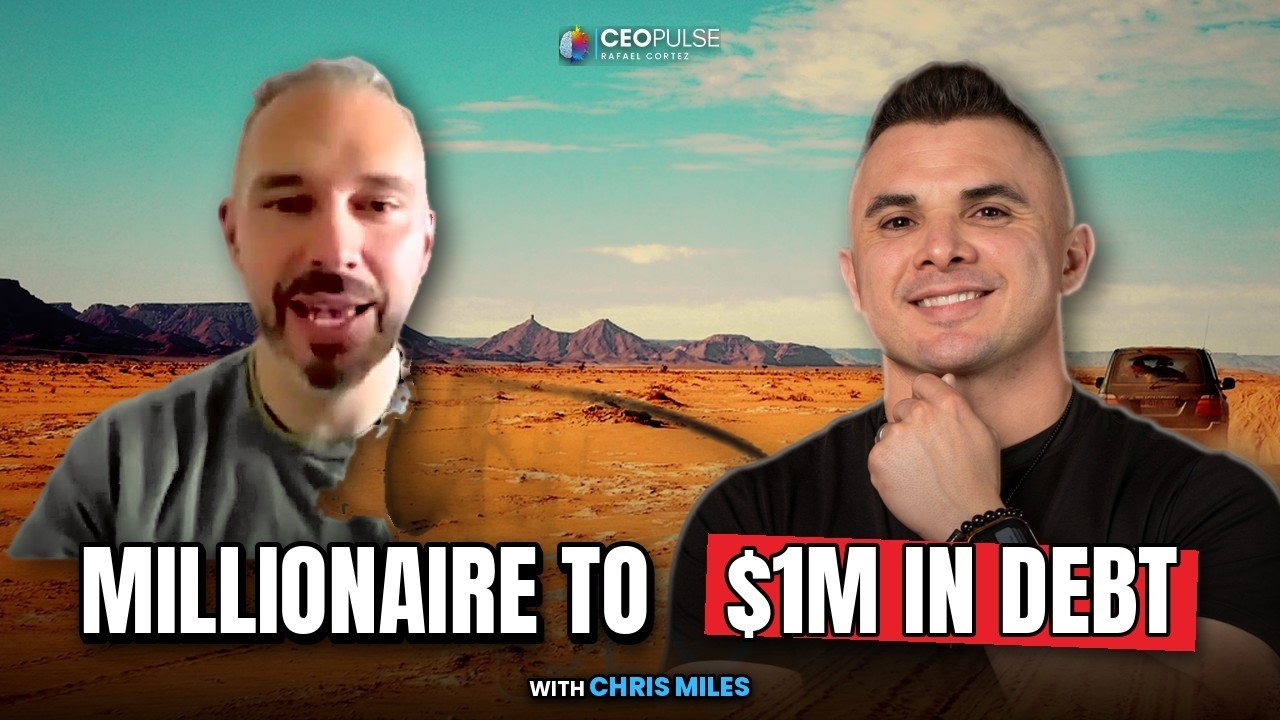
Applying what he learned from self made investors, Chris Miles became work optional at 28. The recession then took him from millionaire to more than a million dollars in debt, and he came close to bankruptcy before rebuilding and reaching financial independence again in 2016. Rafael Cortez says that once entrepreneurs leave survival mode, many naturally turn toward contribution.
Why do dollars follow value?
Rafael Cortez grew up seeing a modest salary as the limit of financial vision and asks how Chris Miles raised his financial thermostat. Chris Miles says entrepreneurship done right is the best personal development program, because you have to learn every role. Early on, his best paying job paid under 12 dollars an hour. What changed him was learning from abundant thinking investors and entrepreneurs. He rejects hustle culture: it is not about working harder or even smarter, but about working right.
The key principle is that dollars follow the value you create for other people. Use your gifts, strengths and passions, what he calls your divine genius, to serve people and solve problems so money becomes a natural byproduct. He was raised to believe rich people were jerks, but economics rewards companies like Apple and Tesla because they deliver value to many people.
He learned it firsthand. When he cut his fees as a mortgage broker, people often trusted him less. When he charged the standard fee and partnered with someone to handle the paperwork, clients gave better feedback and sent more referrals. Rafael Cortez tells agents in his brokerage not to cut commissions for the same reason. Chris Miles describes an agent who charged a full commission but staged his home herself, helping it sell for far more. Asking how to make more money is like asking a grocery store for more receipts. Ask how to create more value for more people. Rafael Cortez adds that he watches his team's financial goals, knowing his results follow theirs.
How should you start and grow?
If you are bootstrapping, Chris Miles says just start. A marketing mentor taught him to ask what the fastest way to cash is. Launch something small, generate revenue and level up like a video game. His mantra is dream big, but think small. Rafael Cortez connects it to the minimum viable product and the muse idea from Tim Ferriss's The 4 Hour Workweek.
When Chris Miles launched Money Ripples under a two year noncompete, he started from scratch in a new market of women entrepreneurs in Utah. He spent a modest amount taking centers of influence to breakfast and lunch and spent the time asking about them, looking for one way to help each person. Soon people across those circles were talking about him, speaking invitations followed and he reached six figures in his first year, months before his website launched. Rafael Cortez contrasts this with cold LinkedIn pitches and recalls a photographer who reached out simply to show him a new camera, which opened a real conversation.
The ripple effect of leading with value
Chris Miles adds that when you create value, you should also be willing to ask for something small in return, like a referral. An early connection led to a chapter in John Lee Dumas's Entrepreneurs on Fire book and an appearance on his show. A later appearance led to another podcast, then another, then a client and a chain of relationships that grew his business far beyond what he expected. You never know which small action will set off the next step.
How do you free up cash flow?
Rafael Cortez recalls his firefighter days, when every hour in was an hour out. As an entrepreneur, one meeting can turn into something big months later. He reviews each day before bed and sometimes cannot tell whether he accomplished a lot or nothing, because the ripple effect of a meeting is not visible yet. Chris Miles agrees that big results come from small choices that compound. He cites Three Feet From Gold by Greg Reid and Sharon Lechter, in which many entrepreneurs say it took them 10 years to become an overnight success. Momentum is like a bicycle: first gear is hard, then you fly.
Chris Miles stresses that this is not individual financial advice. Business owners should get profitable, and he points to Mike Michalowicz's Profit First: reinvesting every dollar means you are spending, not profiting. Once reinvestment stops paying the same return, look at other options. He shares client stories: a business owner in her fifties who used savings to buy cash flowing rentals and other income investments and moved to Bali; a chiropractor who was paying down mortgages on properties producing little cash flow and instead repositioned that equity to create much more income; and a practice owner in his sixties who restructured debt, freed up monthly cash flow, felt less stressed and became passionate about his work again, which increased his revenue.
Asked what he would tell his 17 year old self, Chris Miles says skip the traditional path if you want freedom: find someone who has been there, done that and is still doing it today, then work for them, even for free, and learn the skills from the field. Rafael Cortez calls it a tool for the level up game everyone needs.
Key takeaways
- Control risk. Chris Miles says risk means chance of loss, so smart owners keep it low.
- Dollars follow value. Ask how to create more value for more people, not how to make more money.
- Do not discount your worth. Charging standard fees and adding value earned Chris Miles more trust and referrals.
- Dream big, think small. Launch the fastest path to cash, then level up.
- Lead with value. Small acts of service create ripple effects that compound over years.
Quotes from the conversation
“A 90% chance of losing does not mean you have a 90% chance of winning.”
Chris Miles, 4:34
“It's not about working harder. It's not even about working smarter. It's about working right.”
Chris Miles, 17:24
“Dollars follow the value you create for other people.”
Chris Miles, 17:39
“Dream big, but think small”
Chris Miles, 23:22
Episode chapters
| 0:00 | Welcome Chris Miles |
| 0:45 | The anti financial advisor |
| 3:08 | Why entrepreneurs should control risk |
| 7:01 | From ballroom dancer to financial advisor |
| 10:12 | The question that changed his career |
| 15:02 | Raising your financial thermostat |
| 17:24 | Dollars follow value |
| 22:10 | Dream big, think small |
| 29:55 | The ripple effect of leading with value |
| 36:56 | Freeing up cash flow and advice to his 17 year old self |
Who is on this episode?
Chris Miles
Chris Miles is a cash flow specialist known as the anti financial advisor, founder and CEO of Money Ripples and host of the Chris Miles Money Show. A former commission only financial advisor, he helps entrepreneurs and professionals create cash flow and become work optional.
About the host: Rafael Cortez
Rafael Cortez is the host of the CEO Pulse Podcast, an Organizational Psychologist and a real estate broker and investor based in Phoenix, Arizona. Raised in Yuma, Arizona, he became one of the youngest firefighters in Yuma County at 19 and launched his first business at 21. He has been involved in more than 1,300 real estate deals since 2009 and mentors entrepreneurs through the L.E.S.S. Business philosophy: Lean, Effective, Strategic, Simple. Rafael is the founder of CEO Pulse, Pulse Realty and Pulse Capital and the creator of REI Pulse CRM, and he mentors wholesalers in group and 1 on 1 settings. Read Rafael Cortez’s full bio.
Questions and answers
Who is Chris Miles?
Chris Miles is a cash flow specialist, founder of Money Ripples and host of the Chris Miles Money Show. He calls himself the anti financial advisor because he left traditional financial advice to focus on cash flow.
Why does Chris Miles say high risk does not mean high returns?
Risk means chance of loss, so a higher chance of losing is not a higher chance of winning. Chris Miles says good business owners work to keep risk low.
What does dollars follow value mean?
Money is a byproduct of the value you create for others. Chris Miles tells Rafael Cortez to ask how to serve more people instead of how to make more money.
Should you discount your fees to win clients?
Chris Miles found that clients trusted him less when he cut fees and referred more when he charged standard rates. Rafael Cortez gives agents in his brokerage the same advice.
What is dream big, think small?
It means keeping a big vision while launching the smallest offer that generates revenue quickly. Chris Miles says you then level up like a video game.
What would Chris Miles tell his 17 year old self?
Chris Miles would say find someone who has been there, done that and is still doing it, then work for them to learn the skills. He sees that as a better investment than the traditional path.
Related episodes
Build your business on systems
Rafael Cortez built REI Pulse CRM from the systems he runs his own deals on. See how it works for wholesalers and investors.
Explore REI PulseBrowse every CEO Pulse Podcast episode · About Rafael Cortez · YouTube · Apple Podcasts · Spotify
