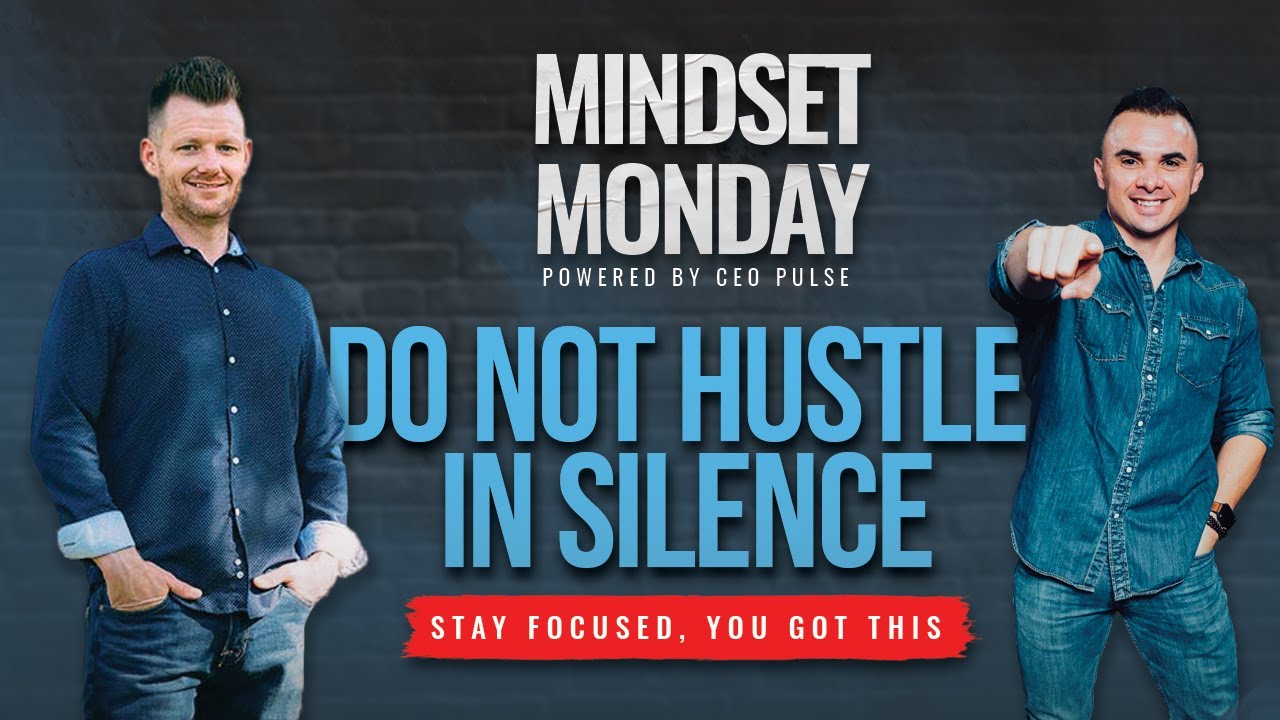

CEO Pulse Podcast | Mindset Monday
TL;DR
In this Mindset Monday episode, Rafael Cortez and co host Justin Thorstad push back on the popular advice to hustle in silence. They explain how sharing your goals invites collaboration and accountability, why asking for help takes courage, and how Justin Thorstad reached his hiring goal by telling 100 people in 10 days.
What you will learn in this episode
- Why Rafael Cortez and Justin Thorstad reject the hustle in silence meme
- How sharing big goals brings support and partnerships
- Why asking for help takes courage and vulnerability
- The 100 people in 10 days exercise that produced five referrals
- How accountability and conviction grow when you speak your goals
- Collaboration over competition as an abundance mindset
Should entrepreneurs hustle in silence?
What is wrong with the hustle in silence advice?
Rafael Cortez, host of the CEO Pulse Podcast and an Organizational Psychologist, opens this Mindset Monday episode with co host Justin Thorstad by calling out a popular social media meme: work in silence and do not share your dreams, because envy or outside energy can throw you off. Rafael Cortez admits this may be an unpopular opinion, but he does not think keeping your hustle under wraps serves anyone.
Justin Thorstad agrees strongly. When you have a C type goal, one so big you have no idea how to reach it, you will need outside support, new information, collaborations and partnerships. You cannot get those if you keep your mouth shut. Trying to reach a big goal through pure hustle is a way, he says, but not the way. It costs time and energy that you take from your partner, your kids, your relationships and your health.
Can other people's opinions really derail you?
Justin Thorstad pushes back on the idea that outside energy can knock you off course. In his workshop, participants write down their truths, the absolutes that remind them who they are. One of his truths is that no one can knock him off his center unless he allows it. Judgment, envy or jealousy cannot derail him because he is resolute about who he is and where he is going. Getting distracted or going victim is his choice.
He then flips the logic. If negative outside energy can disrupt you, the opposite must also be true. Tell people about your goal repeatedly and you can enroll support, collaboration, partnerships and resources you did not know existed. You might even inspire someone who sees you leading yourself and wants to join your vision.
Why do some cultures tell people to keep goals secret?
Rafael Cortez notes that people easily share collective energy at a soccer game or a concert, so why not when building their own dreams? He believes we set our own limits through cultural expectations. Growing up Hispanic, he says, the norm was to keep your business to yourself out of fear that someone would take your idea or wish you harm. He is not criticizing his culture, just naming a scarcity mindset found in many cultures.
Rafael Cortez suggests turning it around. Start with a positive idea, put it out there, and focus on the good it can bring. He has seen new relationships and unexpected opportunities line up time and again. It takes bravery, and once you speak your goal, accountability kicks in because you want to honor your word.
How does asking for help open new doors?
Justin Thorstad shares a recent example. He asked Rafael Cortez who might sponsor his next seminar, and Rafael Cortez gave him a contact. That conversation turned into a partnership that filled a gap in a new venture Justin Thorstad is building, with services he has no desire to learn himself. He remembers his stepdad telling him as a small child that you do not deserve anything you do not ask for, and that stuck with him.
Asking takes courage because it means admitting a gap. Many people want to project that they have it all together. Justin Thorstad says vulnerability is courageous, and courage only exists alongside fear. Courage is feeling the fear and moving forward anyway.
Rafael Cortez admits asking for help has been one of his own challenges. He recently told a friend about an investment strategy he had been exploring, and the friend came to his office and spent an hour clearing up his doubts. That strategy could become a significant new source of revenue, and it would not have happened if he had hustled in silence. When he has asked for help, complete pivots happened.
Why work alone when you can build with others?
Justin Thorstad says anyone starting a new venture will be insufficient at first. Even if you could learn every role, why would you want to work 100 hours a week? He runs several businesses and works only a few hours a day by thinking about scalability and leverage, which requires outside support. Rafael Cortez shares a saying from his real estate community in Phoenix: collaboration over competition. Getting there starts with a conversation with yourself and accepting that you do not know everything.
Justin Thorstad says he is good at asking for support partly because of a belief he formed as a child that he was not smart enough. As a struggling student he absorbed negative messages from adults around him, even though no one intended harm. He turned that belief into a strength: instead of building a 100 step plan alone, he gets into action and asks people who already know. He focuses on his strengths and delegates the rest. He mentions asking Rafael Cortez for help with an online mentorship product, and Rafael Cortez describes how helping a long time friend with KPIs and systems for years came back to him when he needed help. That is the law of reciprocity.
Rafael Cortez adds that hustling in silence is often driven by scarcity or by fragile confidence and a fear that someone will pull the rug out from under you. When you stay busy focusing on the positive, your mind has less room to wander toward bad possibilities.
How did telling 100 people help Justin Thorstad hit his goal?
Justin Thorstad began his personal development work in October 2014. In January 2015 he decided to build a real estate team and set a 90 day goal to hire five agents, with no idea how. He researched strategies, hustled and ground for 90 days, and hired one agent.
His mentor then gave him a new assignment for the next 90 days: tell 10 different people a day about his goal for 10 days, 100 people in total. The goal scared him because he did not believe it yet. Each time he said it out loud, his energy around the goal rose and it began to fit his self image. By the end of that 90 days he had his five agents, and all five were referred by people he had told. His own hustle produced 20 percent of the result, while simply sharing the goal produced 100 percent.
Around day six he had only told two people. His mentor had him stand on a table in a coffee shop with his accountability partner recording and announce his 90 day goals. He was angry and scared but did it anyway, and people clapped and came up to talk with him. He felt proud and empowered. Rafael Cortez adds that speaking your goals creates conviction, since it is easy to tell the voice in your head you will do it next year. He has often shared an idea and had someone show him a way to get there six months faster.
What does it mean to live out loud?
Justin Thorstad explains that as a visionary he enrolls people who are skilled in each area, sets up win win arrangements so those doing the work share in the results, and focuses on holding the vision and keeping everyone accountable. Rafael Cortez says that over the past few years he has learned to be loud about who he is, what he does and his purpose.
In closing, Rafael Cortez encourages listeners to put good ideas into the world the same way people put out fears and doubts, because one conversation at the right moment can shift someone's life. Justin Thorstad sums it up: you can hustle and struggle in silence, or you can live out loud.
Key takeaways
- Big goals need other people. Support, partnerships and new information come from sharing.
- Only you can derail you. Other people's opinions affect you only if you allow it.
- Asking takes courage. Vulnerability is feeling the fear and asking anyway.
- Speaking goals builds accountability. Saying it out loud creates conviction to follow through.
- Collaboration over competition. An abundance mindset opens doors that hustle alone cannot.
- Live out loud. One conversation can change your path or someone else's.
Quotes from the conversation
“You don't deserve anything you don't ask for”
Justin Thorstad, 9:12
“Courage is feeling the fear moving forward anyways”
Justin Thorstad, 10:06
“You can either hustle and struggle in silence or you can live out loud.”
Justin Thorstad, 27:37
Episode chapters
| 0:00 | Welcome to Mindset Monday |
| 0:46 | The hustle in silence meme |
| 3:04 | No one can knock you off center |
| 5:30 | Culture, scarcity and secrecy |
| 7:50 | Accountability and asking for help |
| 9:27 | Courage and vulnerability |
| 12:33 | Collaboration over competition |
| 18:03 | Telling 100 people in 10 days |
| 21:10 | Standing on a table in a coffee shop |
| 25:46 | Live out loud |
Who is on this episode?
Justin Thorstad
Justin Thorstad is Rafael Cortez's co host on the Mindset Monday series. In this episode he shares how telling his goals to 100 people helped him build his real estate team.
About the host: Rafael Cortez
Rafael Cortez is the host of the CEO Pulse Podcast, an Organizational Psychologist and a real estate broker and investor based in Phoenix, Arizona. Raised in Yuma, Arizona, he became one of the youngest firefighters in Yuma County at 19 and launched his first business at 21. He has been involved in more than 1,300 real estate deals since 2009 and mentors entrepreneurs through the L.E.S.S. Business philosophy: Lean, Effective, Strategic, Simple. Rafael is the founder of CEO Pulse, Pulse Realty and Pulse Capital and the creator of REI Pulse CRM, and he mentors wholesalers in group and 1 on 1 settings. Read Rafael Cortez’s full bio.
Questions and answers
Is hustling in silence good advice for entrepreneurs?
Rafael Cortez and Justin Thorstad say no. Big goals need outside support, collaboration and new information, and you cannot attract those if you keep your goals secret.
Why should you tell people your goals?
Justin Thorstad says sharing goals enrolls support, partnerships and resources you did not know existed. Rafael Cortez adds that it also creates accountability because you want to honor your word.
How did Justin Thorstad hire five agents in 90 days?
Justin Thorstad told 10 different people a day about his goal for 10 days. All five agents he hired came from referrals by people he told, while his own hustle had produced only one hire earlier.
Why is asking for help so hard?
Justin Thorstad says asking means admitting a gap, and many people want to look like they have it all together. He calls vulnerability courageous because courage is feeling fear and acting anyway.
What does collaboration over competition mean?
Rafael Cortez describes it as a saying in his Phoenix real estate community. It reflects an abundance mindset where helping others win also helps you win.
Can other people's negativity derail your goals?
Justin Thorstad believes no one can knock you off your center unless you allow it. If you are clear on who you are and where you are going, judgment and envy lose their power.
Related episodes
Build your business on systems
Rafael Cortez built REI Pulse CRM from the systems he runs his own deals on. See how it works for wholesalers and investors.
Explore REI PulseBrowse every CEO Pulse Podcast episode · About Rafael Cortez · YouTube · Apple Podcasts · Spotify
