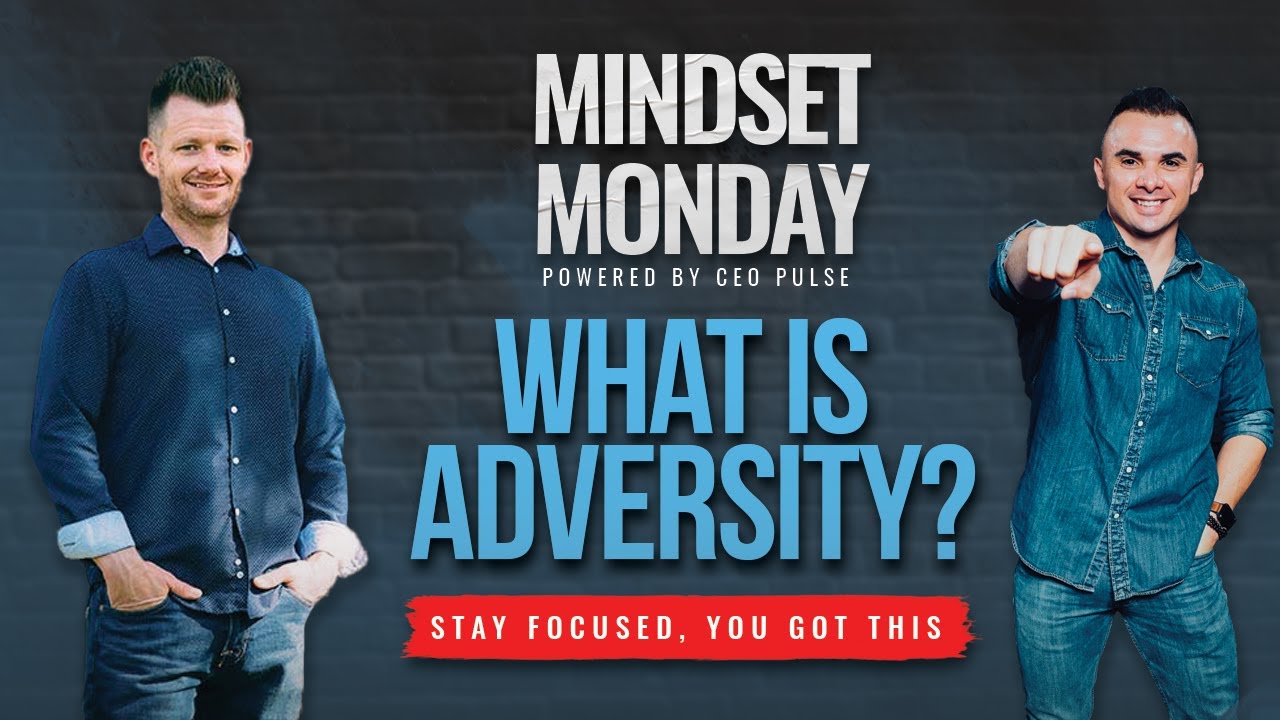

CEO Pulse Podcast | Mindset Monday
TL;DR
In this Mindset Monday episode, Rafael Cortez and co host Justin Thorstad break down adversity: the gap between what you expected and what actually happened. They share how 2020 became a gift for prepared businesses, their personal processes for recovering from the emotional hit, and why asking how this is happening for you changes everything.
What you will learn in this episode
- What adversity really is at its core
- Why the same event can feel like a setback or an opportunity
- The question Justin Thorstad asks instead of what do I do about this
- How Rafael Cortez and Justin Thorstad recover from the emotional hit
- Why emotional awareness shrinks adversity over time
- How to shift from victimhood to an empowered mindset
How should entrepreneurs handle adversity?
What is adversity, really?
Rafael Cortez, host of the CEO Pulse Podcast and an Organizational Psychologist, opens this Mindset Monday episode with co host Justin Thorstad on a topic listeners keep asking about: adversity. What is it, what does it look like, and why does it stop so many people from starting or growing a business?
Justin Thorstad breaks it down to its core. You had an expectation of how things would go, reality unfolded differently, and you are not okay with it. Whether the market shifted or clients dried up, adversity is simply things not going to plan and resisting what is happening. Rafael Cortez adds that society is shifting constantly, so adaptability is now a must. Without a clear blueprint, adversity and adaptability go hand in hand.
Why can the same event be a setback or a gift?
Rafael Cortez points to 2020. Businesses that were already set up to work from home thrived, while many others scrambled. His own businesses had run virtually for years, so it did not even feel like adversity to him.
Justin Thorstad shares that his real estate brokerage was hesitant to move meetings online at first, but honored agents who preferred it. Through 2020 and 2021, the brokerage grew in sales, volume and agent count. His view is that nothing has inherent meaning; we assign it. We do not see things as they are, we see things as we are. Many companies discovered that remote teams were more focused and productive, and that they could cut overhead by dropping commercial space. Productivity went up, expenses went down, and profit grew. The same event that looked like the sky falling turned out to be a gift for those who looked for one.
What question should you ask when adversity hits?
Justin Thorstad says that when most people hit a roadblock, they ask themselves what to do about it. In his experience, the mind answers with old conditioning and programming, so it offers safe and comfortable answers. Instead, he carves out sacred time, meditation in the morning and at night, and asks a different question: what is the lesson here, and what gift is in this situation? He treats every setback as happening for his evolution, his self awareness and his business skills.
Rafael Cortez agrees that anything worthwhile comes from adversity, because adversity pushes you out of your comfort zone. He shares how he and a friend put together a masterclass with less than two weeks of lead time. Building the roster, selling it and flying people in felt like it might crash and burn. He had mapped his own emotional cycle years earlier, so he recognized the swings from euphoria to pessimism and overwhelm. They kept pushing, and it turned out well.
Justin Thorstad says volunteering to step into the fire is where you learn what you are made of. If you only operate from past memories, your future becomes predictable. An unexpected factor in your reality can cause a pivot that makes your business more profitable and more purpose driven, but only if you look for it instead of sliding into fear, doubt and worry.
How do you move from victimhood to empowerment?
Rafael Cortez acknowledges that some adversity is genuine, such as illness or events completely outside your control, and those can be harder to handle. For the everyday challenges in your environment, the attitude you take decides the outcome. Are you building a victim mentality or an empowered one? The key is the ability to check yourself and return to center. He keeps a line from the movie The Hangover in mind for dark moments: but did you die? If not, you still have a fighting chance. The danger is hopelessness, because it leaves you powerless to act.
Justin Thorstad shares a story about one of his agents who did everything herself and treated hustle as a business strategy instead of a season. When her health forced her to step back, her first reaction was that her business would crumble. Energy flows where attention goes, so he encouraged her to look for the lesson instead. She learned she did not have to do it all. Today she focuses on two or three things in her role, and everything else is delegated, outsourced or automated. She is more profitable and more productive while working less. His advice: stop doing what you hate.
How do they recover from the emotional hit?
Justin Thorstad says he rarely reaches hopelessness anymore because of practice and repetition. When things do not go his way, that is his cue. He sits down to meditate after asking what the lesson is and how this will propel him into his next chapter. Sometimes it takes a few sessions, but new insight always comes, and it always leads him to evolve himself and his business.
Rafael Cortez has a different trigger. When he starts thinking about alternate routes that are completely outside his truth, like going back to a nine to five, he knows self doubt is creeping in. That is his red flag to disconnect from the issue, even in the middle of a conference. Because his mind keeps racing, he engages it with something else, like playing the guitar he keeps in his office. That decompresses him, and only then can he sit down, think clearly and meditate. Both agree there is no single right way; there are many ways to create a hard disconnect.
Why does emotional awareness make adversity smaller?
Justin Thorstad says adversity also shows him what he is still holding on to inside. If a situation triggers a strong emotion, it is hitting something stored from the past. Rather than suppress or express the emotion, he sits with it and lets it go so it no longer runs the show.
Rafael Cortez says trying to suppress emotions makes little sense. Old feelings of unworthiness can bubble up even for very successful people at any age. What gives you power is emotional awareness: knowing what you feel and why. He describes a conversation with a friend about how emotional adversity starts as a huge beast that seems ready to eat you alive. As your emotional intelligence grows, it gets smaller and smaller until it is like a tiny dog. It never fully goes away, but it is no longer a threat.
Justin Thorstad adds that a situation never takes you down; you take yourself down with it. You are the witness of your thoughts and feelings, not those thoughts and feelings. The voice of fear becomes a whisper when you keep feeding a new truth, because the one that wins is the one you feed.
How is this happening for you, not to you?
Rafael Cortez closes with a simple question for anyone facing adversity: how is this happening for me, not to me? That shift opens up new possibilities and solutions and moves you from victimhood and hopelessness into empowerment.
Justin Thorstad adds a simple truth he returns to often. If there is a problem, there is inherently a solution, but you have to approach it with a different mindset than the one that created the situation. As he puts it, your personality creates your personal reality, so if you want a different reality, you have to grow into a different person.
Key takeaways
- Adversity is unmet expectations. Reality unfolded differently than you planned.
- Meaning is assigned. The same event can be a setback or a gift.
- Ask a better question. What is the lesson here, not what do I do.
- Create a hard disconnect. Step away before you try to solve it.
- Awareness shrinks the beast. Emotional intelligence makes adversity smaller over time.
- It happens for you. Every problem carries a solution.
Quotes from the conversation
“We don't see things as they are, we see things as we are”
Justin Thorstad, 5:07
“I really do think that anything worthwhile comes from adversity.”
Rafael Cortez, 6:50
“How is this happening for me? Not to me.”
Rafael Cortez, 27:31
Episode chapters
| 0:46 | What is adversity? |
| 2:19 | Expectations versus reality |
| 3:56 | What 2020 taught businesses |
| 5:28 | What is the lesson here? |
| 7:51 | Scrambling to build a masterclass |
| 12:30 | Victimhood versus empowerment |
| 15:41 | Recovering from the emotional hit |
| 18:45 | Creating a hard disconnect |
| 21:03 | Emotional awareness and letting go |
| 27:23 | Happening for you, not to you |
Who is on this episode?
Justin Thorstad
Justin Thorstad is the co host of the CEO Pulse Podcast Mindset Monday episodes. He runs a real estate brokerage and leads workshops on mindset, purpose and business structure for entrepreneurs.
About the host: Rafael Cortez
Rafael Cortez is the host of the CEO Pulse Podcast, an Organizational Psychologist and a real estate broker and investor based in Phoenix, Arizona. Raised in Yuma, Arizona, he became one of the youngest firefighters in Yuma County at 19 and launched his first business at 21. He has been involved in more than 1,300 real estate deals since 2009 and mentors entrepreneurs through the L.E.S.S. Business philosophy: Lean, Effective, Strategic, Simple. Rafael is the founder of CEO Pulse, Pulse Realty and Pulse Capital and the creator of REI Pulse CRM, and he mentors wholesalers in group and 1 on 1 settings. Read Rafael Cortez’s full bio.
Questions and answers
What is adversity in business?
Justin Thorstad defines adversity as reality unfolding differently than you expected and not being okay with it. Whether the market shifts or clients slow down, the core is unmet expectations.
How can adversity become an opportunity?
Rafael Cortez says anything worthwhile comes from adversity because it pushes you out of your comfort zone. In 2020, many companies found that remote work raised productivity and cut overhead.
What question should you ask when things go wrong?
Justin Thorstad asks what the lesson is and what gift the situation holds, instead of what to do about it. He says the second question only returns your old conditioning.
How does Rafael Cortez recover from the emotional hit of adversity?
Rafael Cortez treats self doubt as a cue to disconnect from the problem. He engages his mind with something else, like playing guitar, and then returns to think and meditate.
Why does emotional intelligence matter when facing adversity?
Rafael Cortez says emotional adversity starts as a huge beast and shrinks as your emotional awareness grows. Justin Thorstad adds that you are the witness of your feelings, not your feelings.
What does happening for me, not to me mean?
Rafael Cortez says asking how a setback is happening for you shifts you from victimhood into empowerment. Justin Thorstad adds that every problem inherently carries a solution.
Related episodes
Build your business on systems
Rafael Cortez built REI Pulse CRM from the systems he runs his own deals on. See how it works for wholesalers and investors.
Explore REI PulseBrowse every CEO Pulse Podcast episode · About Rafael Cortez · YouTube · Apple Podcasts · Spotify
